


Key Insights
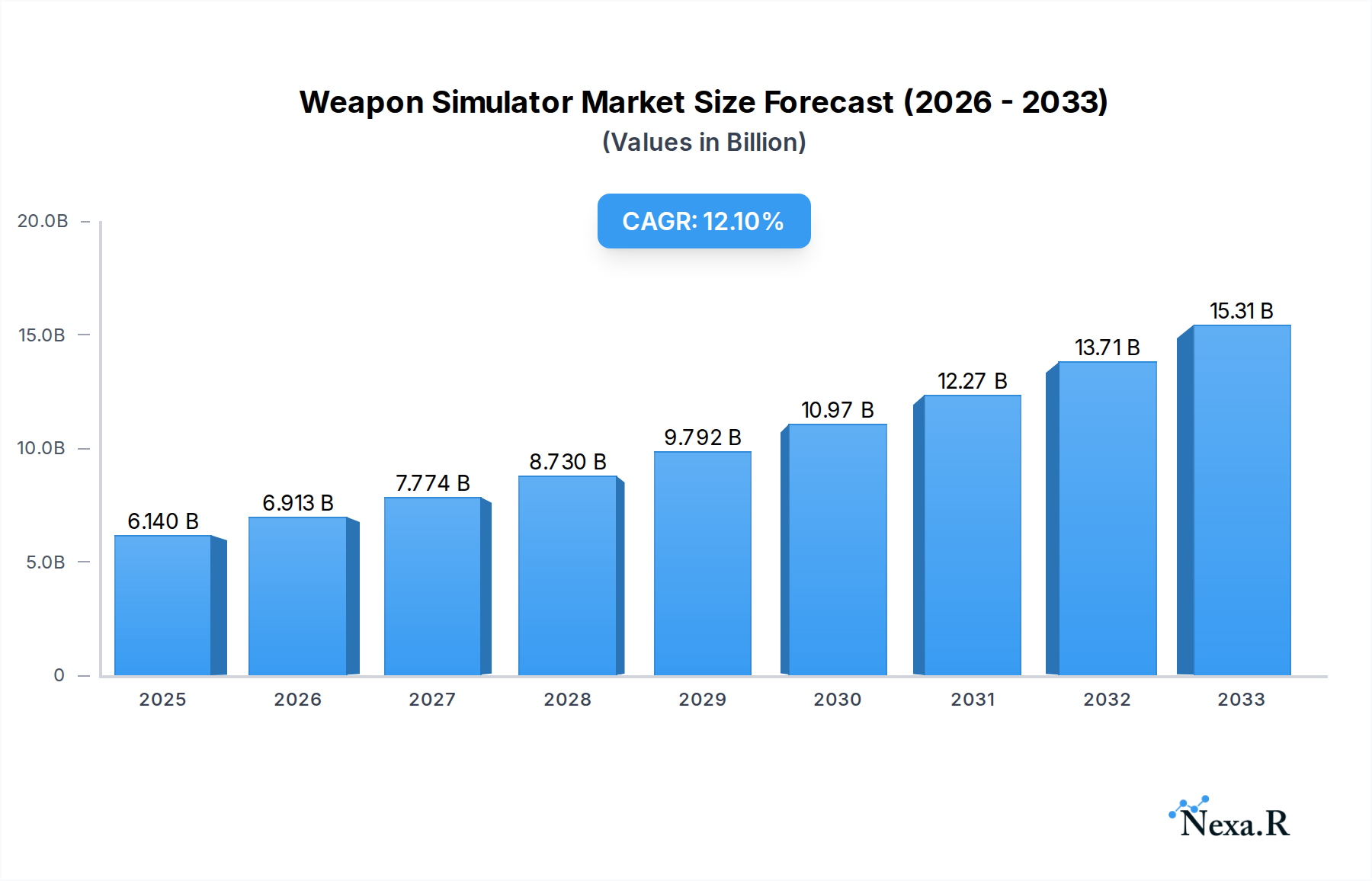
The global Weapon Simulator market is poised for significant expansion, with a projected market size of USD 6.14 billion in 2025. This robust growth is fueled by an impressive CAGR of 13.16% anticipated over the forecast period from 2025 to 2033. The increasing demand for advanced training solutions within law enforcement and military sectors is a primary driver, offering a cost-effective and safer alternative to live-fire exercises. Technological advancements, including the integration of virtual reality (VR), augmented reality (AR), and artificial intelligence (AI), are enhancing the realism and effectiveness of these simulators, further propelling market adoption. The growing emphasis on force readiness, sophisticated threat simulation, and continuous skill development for personnel across various defense and security agencies are creating substantial opportunities for market players.
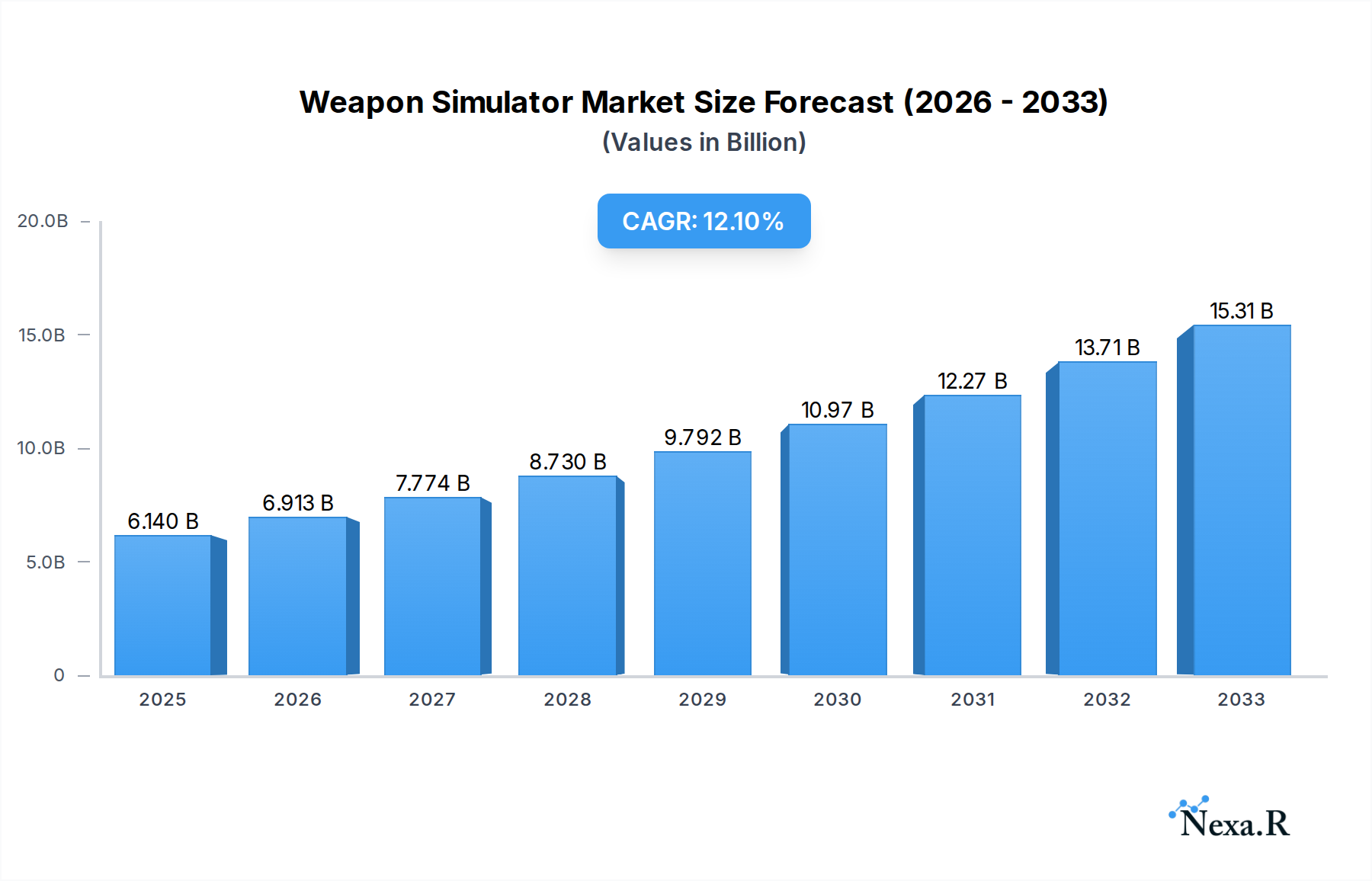
Weapon Simulator Market Size (In Billion)

The market is segmented into Virtual Weapon Simulators and Interactive Weapon Simulators, catering to diverse training needs. Key applications span Law Enforcement, Military, Shooting Ranges, and other niche areas. Geographically, North America and Europe are expected to maintain a dominant share due to established defense budgets and a proactive approach to technological adoption in training. However, the Asia Pacific region is demonstrating rapid growth, driven by increasing defense expenditures and the modernization of military and police forces. Restraints include the initial high cost of sophisticated simulator systems and the need for continuous software updates. Despite these challenges, the persistent need for enhanced combat readiness, tactical proficiency, and the reduction of training-related risks will continue to drive the weapon simulator market towards sustained and substantial growth.
Weapon Simulator Company Market Share
Weapon Simulator Market Report: Trends, Opportunities, and Key Players (2019-2033)
This comprehensive report provides an in-depth analysis of the global Weapon Simulator market, offering critical insights into its dynamics, growth trajectory, and future outlook. Leveraging extensive data from the historical period (2019-2024), base year (2025), and forecast period (2025-2033), this study illuminates the strategic imperatives for stakeholders. The study period spans from 2019 to 2033, ensuring a robust understanding of past trends and future projections.
Weapon Simulator Market Dynamics & Structure
The global Weapon Simulator market is characterized by a moderate to high concentration, with a few key players dominating the landscape. Technological innovation remains a significant driver, fueled by the persistent need for realistic and cost-effective training solutions for military and law enforcement agencies. The increasing adoption of virtual reality (VR) and augmented reality (AR) technologies is reshaping the product offerings, pushing the boundaries of immersive training experiences. Regulatory frameworks, particularly concerning defense spending and training mandates, play a crucial role in shaping market accessibility and adoption rates. Competitive product substitutes, such as live-fire exercises, present a challenge, but the cost-effectiveness, safety, and repeatable nature of simulators offer distinct advantages. End-user demographics are diverse, encompassing a wide range of military branches, police departments, and private security firms, each with unique training requirements. Mergers and acquisitions (M&A) are a notable trend, as larger companies seek to consolidate market share and acquire specialized technological capabilities.
- Market Concentration: Dominated by key players, but with emerging niche providers.
- Technological Innovation: Driven by VR/AR integration, advanced AI, and haptic feedback systems.
- Regulatory Frameworks: Influenced by national defense budgets, training standards, and safety regulations.
- Competitive Product Substitutes: Live-fire training remains a substitute, but simulation offers cost and safety benefits.
- End-User Demographics: Military, Law Enforcement, Shooting Ranges, and Private Security sectors.
- M&A Trends: Strategic acquisitions to enhance technological portfolios and market reach.
Weapon Simulator Growth Trends & Insights
The global Weapon Simulator market is poised for robust expansion, driven by escalating defense budgets, heightened security concerns, and the continuous evolution of warfare tactics. The market size is projected to reach USD 5.8 billion in 2025, with an anticipated Compound Annual Growth Rate (CAGR) of 6.7% during the forecast period (2025-2033). This sustained growth is underpinned by increasing adoption rates across various applications, most notably in military and law enforcement training. Technological disruptions are a constant factor, with the integration of AI-powered adversaries, advanced analytics for performance assessment, and more sophisticated sensor technology enhancing realism and training effectiveness. Consumer behavior shifts are evident, with a growing preference for scenario-based training that mimics real-world situations, promoting decision-making skills and tactical proficiency. The market penetration is expected to deepen as more organizations recognize the long-term cost savings and improved training outcomes associated with simulator technology. The ability of these systems to provide objective performance metrics and repeatable training scenarios is increasingly valued, moving beyond traditional methods. The market size is expected to reach USD 9.8 billion by 2033.
Dominant Regions, Countries, or Segments in Weapon Simulator
The Military segment stands as the dominant force driving growth in the global Weapon Simulator market. This dominance is primarily attributed to the substantial defense budgets allocated by governments worldwide, coupled with the persistent need for advanced and realistic training for their armed forces. The Military segment is projected to account for approximately 45% of the total market share in 2025. The United States, with its significant military expenditure and continuous investment in modernization of training programs, represents the leading country within this segment.
Dominant Segment: Military
- Market Share (2025): Approximately 45% of the total market.
- Key Drivers: High defense spending, modernization of armed forces, demand for realistic combat simulation, evolving geopolitical landscapes, and focus on joint force training.
- Growth Potential: Continued investment in advanced simulation technologies to prepare for complex, multi-domain warfare.
Dominant Region: North America
- Market Share (2025): Expected to hold over 35% of the global market.
- Key Drivers: The United States' extensive military presence, significant defense procurement, and proactive adoption of cutting-edge training technologies. Canada also contributes to this dominance through its defense modernization initiatives.
- Infrastructure: Well-established defense industry, robust research and development capabilities, and a strong network of simulation technology providers.
Dominant Type: Virtual Weapon Simulator
- Market Share (2025): Projected to capture over 60% of the total market by type.
- Key Drivers: Cost-effectiveness compared to live-fire training, enhanced safety, ability to simulate diverse scenarios and environments, and integration with advanced technologies like VR and AR.
- Technological Advancements: Continuous improvements in graphics, physics engines, and artificial intelligence leading to highly immersive and realistic training experiences.
The Law Enforcement segment is also a significant contributor, driven by the need for effective and safe training for police officers in de-escalation techniques, active shooter response, and tactical maneuvers. The Law Enforcement segment is expected to grow at a CAGR of 7.2% during the forecast period. The Shooting Range segment, while smaller, is witnessing growth due to the increasing popularity of recreational shooting and the demand for enhanced safety and skill development tools.
Weapon Simulator Product Landscape
The Weapon Simulator product landscape is continuously evolving with a strong emphasis on realism and advanced functionality. Innovations include the integration of high-fidelity graphics, realistic physics engines, and accurate ballistics modeling to replicate real-world weapon behavior. The incorporation of haptic feedback systems and motion platforms provides users with tactile sensations and a sense of weapon recoil, significantly enhancing immersion. Furthermore, the development of AI-driven non-player characters (NPCs) allows for dynamic and adaptive training scenarios, challenging users with unpredictable threats and situations. Key product applications range from basic marksmanship training to complex tactical mission simulations, catering to diverse needs within military, law enforcement, and civilian shooting range environments. The unique selling propositions often lie in the modularity of systems, the ease of scenario customization, and the ability to generate detailed performance analytics.
Key Drivers, Barriers & Challenges in Weapon Simulator
Key Drivers:
- Technological Advancements: The relentless progress in VR, AR, AI, and sensor technology fuels the development of more realistic and immersive simulators.
- Cost-Effectiveness: Simulators offer a significantly lower cost per training hour compared to live-fire exercises, especially for large-scale operations.
- Safety and Environmental Concerns: Simulators eliminate the risks associated with live ammunition and minimize environmental impact.
- Mandatory Training Requirements: Stringent training mandates for military and law enforcement personnel drive sustained demand.
- Geopolitical Instability: Increased global security concerns necessitate advanced training solutions for armed forces.
Key Barriers & Challenges:
- High Initial Investment: The upfront cost of sophisticated simulator systems can be a significant barrier for smaller organizations.
- Technological Obsolescence: Rapid advancements can lead to the quick obsolescence of existing hardware and software.
- Integration Complexity: Integrating simulators with existing training infrastructure and IT systems can be complex and time-consuming.
- Maintaining Realism: Achieving perfect replication of all weapon characteristics and environmental factors remains an ongoing challenge.
- Regulatory Hurdles: Evolving procurement processes and certifications can sometimes delay market entry for new technologies.
- Supply Chain Disruptions: Global supply chain issues can impact the availability of critical components, affecting production timelines.
Emerging Opportunities in Weapon Simulator
Emerging opportunities in the Weapon Simulator market are largely centered around the expansion of virtual and augmented reality integration for more immersive experiences. The increasing demand for customizable and scenario-specific training modules presents a significant avenue for growth, allowing end-users to tailor simulations to their precise operational needs. The development of portable and modular simulator systems opens up new markets for smaller agencies and remote training deployments. Furthermore, the application of AI for performance analysis and personalized training feedback offers a compelling value proposition. The growth of the private security sector and the increasing focus on civilian safety training also present untapped market potential.
Growth Accelerators in the Weapon Simulator Industry
Several factors are accelerating the growth of the Weapon Simulator industry. Technological breakthroughs in AI are enabling more intelligent and adaptive training scenarios, while advancements in VR and haptic technology are delivering unprecedented levels of realism. Strategic partnerships between simulator manufacturers and defense contractors are crucial for integrating advanced simulation capabilities into broader defense systems. The growing recognition of simulation as a vital component of modern training doctrines, rather than a mere supplement, is a significant growth accelerator. Furthermore, the continuous drive for operational efficiency and cost reduction within defense and law enforcement agencies strongly favors the adoption of simulator technology.
Key Players Shaping the Weapon Simulator Market
- Guardiaris
- InVeris
- Thales Group
- John Cockerill
- L3Harris Technologies
- Laser Shot
- Zen AWeSim
- Marksman
- MILO
- Raytheon
- Ring's Manufacturing
- Saab
Notable Milestones in Weapon Simulator Sector
- 2021: InVeris completes acquisition of CDS – enhancing its simulation portfolio.
- 2022: Thales Group unveils new generation of virtual training solutions leveraging AI.
- 2022: Laser Shot introduces advanced AR integration for enhanced situational awareness training.
- 2023: L3Harris Technologies secures major contract for advanced military vehicle simulators.
- 2023: Zen AWeSim launches innovative virtual reality weapon system for small arms training.
- 2023: Raytheon develops next-gen simulator for advanced fighter jet training.
- 2024: MILO launches expanded suite of judgmental use-of-force training simulators.
- 2024: John Cockerill showcases integrated simulation solutions for armored vehicle crews.
- 2024: Marksman introduces advanced ballistic tracking technology for range simulators.
- 2024: Ring's Manufacturing expands its line of realistic firearm training devices.
In-Depth Weapon Simulator Market Outlook
The future of the Weapon Simulator market is exceptionally promising, driven by sustained investment in defense modernization, evolving security threats, and the rapid pace of technological innovation. The increasing integration of AI and VR will continue to enhance realism and effectiveness, leading to more sophisticated and personalized training experiences. Strategic collaborations between key players, coupled with a focus on developing modular and scalable solutions, will further fuel market expansion. The growing adoption in law enforcement and civilian applications, alongside the traditional military sector, indicates a broad and enduring demand for advanced simulation capabilities. The market is well-positioned for continued robust growth, offering significant opportunities for companies that can adapt to the evolving technological landscape and meet the dynamic training needs of their clientele.
Weapon Simulator Segmentation
-
1. Application
- 1.1. Law Enforcement
- 1.2. Military
- 1.3. Shooting Range
- 1.4. Others
-
2. Type
- 2.1. Virtual Weapon Simulator
- 2.2. Interactive Weapon Simulator
Weapon Simulator Segmentation By Geography
-
1. North America
- 1.1. United States
- 1.2. Canada
- 1.3. Mexico
-
2. South America
- 2.1. Brazil
- 2.2. Argentina
- 2.3. Rest of South America
-
3. Europe
- 3.1. United Kingdom
- 3.2. Germany
- 3.3. France
- 3.4. Italy
- 3.5. Spain
- 3.6. Russia
- 3.7. Benelux
- 3.8. Nordics
- 3.9. Rest of Europe
-
4. Middle East & Africa
- 4.1. Turkey
- 4.2. Israel
- 4.3. GCC
- 4.4. North Africa
- 4.5. South Africa
- 4.6. Rest of Middle East & Africa
-
5. Asia Pacific
- 5.1. China
- 5.2. India
- 5.3. Japan
- 5.4. South Korea
- 5.5. ASEAN
- 5.6. Oceania
- 5.7. Rest of Asia Pacific
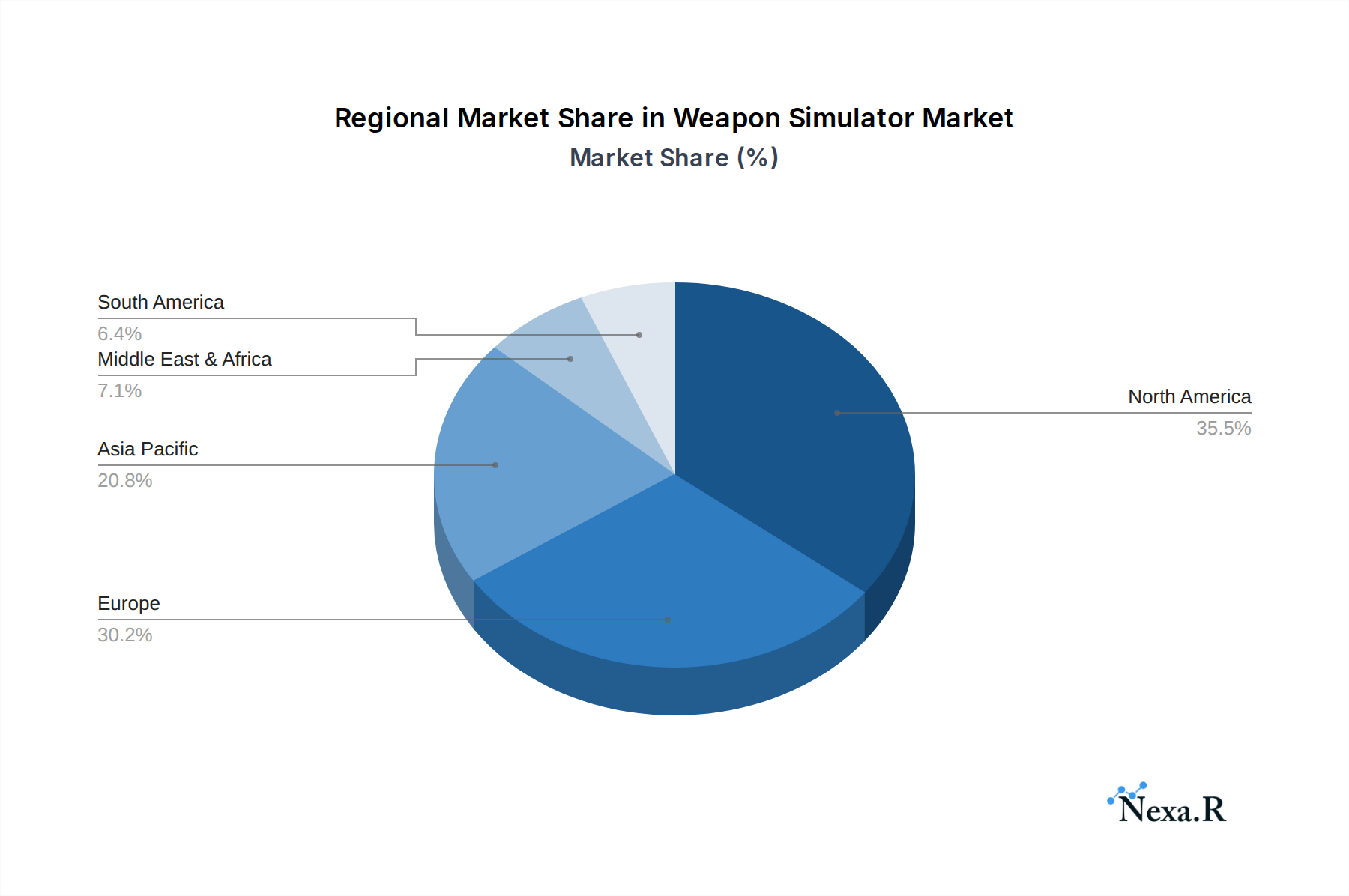
Weapon Simulator Regional Market Share
Geographic Coverage of Weapon Simulator
Weapon Simulator REPORT HIGHLIGHTS
| Aspects | Details |
|---|---|
| Study Period | 2020-2034 |
| Base Year | 2025 |
| Estimated Year | 2026 |
| Forecast Period | 2026-2034 |
| Historical Period | 2020-2025 |
| Growth Rate | CAGR of 13.16% from 2020-2034 |
| Segmentation |
|
Table of Contents
- 1. Introduction
- 1.1. Research Scope
- 1.2. Market Segmentation
- 1.3. Research Methodology
- 1.4. Definitions and Assumptions
- 2. Executive Summary
- 2.1. Introduction
- 3. Market Dynamics
- 3.1. Introduction
- 3.2. Market Drivers
- 3.3. Market Restrains
- 3.4. Market Trends
- 4. Market Factor Analysis
- 4.1. Porters Five Forces
- 4.2. Supply/Value Chain
- 4.3. PESTEL analysis
- 4.4. Market Entropy
- 4.5. Patent/Trademark Analysis
- 5. Global Weapon Simulator Analysis, Insights and Forecast, 2020-2032
- 5.1. Market Analysis, Insights and Forecast - by Application
- 5.1.1. Law Enforcement
- 5.1.2. Military
- 5.1.3. Shooting Range
- 5.1.4. Others
- 5.2. Market Analysis, Insights and Forecast - by Type
- 5.2.1. Virtual Weapon Simulator
- 5.2.2. Interactive Weapon Simulator
- 5.3. Market Analysis, Insights and Forecast - by Region
- 5.3.1. North America
- 5.3.2. South America
- 5.3.3. Europe
- 5.3.4. Middle East & Africa
- 5.3.5. Asia Pacific
- 5.1. Market Analysis, Insights and Forecast - by Application
- 6. North America Weapon Simulator Analysis, Insights and Forecast, 2020-2032
- 6.1. Market Analysis, Insights and Forecast - by Application
- 6.1.1. Law Enforcement
- 6.1.2. Military
- 6.1.3. Shooting Range
- 6.1.4. Others
- 6.2. Market Analysis, Insights and Forecast - by Type
- 6.2.1. Virtual Weapon Simulator
- 6.2.2. Interactive Weapon Simulator
- 6.1. Market Analysis, Insights and Forecast - by Application
- 7. South America Weapon Simulator Analysis, Insights and Forecast, 2020-2032
- 7.1. Market Analysis, Insights and Forecast - by Application
- 7.1.1. Law Enforcement
- 7.1.2. Military
- 7.1.3. Shooting Range
- 7.1.4. Others
- 7.2. Market Analysis, Insights and Forecast - by Type
- 7.2.1. Virtual Weapon Simulator
- 7.2.2. Interactive Weapon Simulator
- 7.1. Market Analysis, Insights and Forecast - by Application
- 8. Europe Weapon Simulator Analysis, Insights and Forecast, 2020-2032
- 8.1. Market Analysis, Insights and Forecast - by Application
- 8.1.1. Law Enforcement
- 8.1.2. Military
- 8.1.3. Shooting Range
- 8.1.4. Others
- 8.2. Market Analysis, Insights and Forecast - by Type
- 8.2.1. Virtual Weapon Simulator
- 8.2.2. Interactive Weapon Simulator
- 8.1. Market Analysis, Insights and Forecast - by Application
- 9. Middle East & Africa Weapon Simulator Analysis, Insights and Forecast, 2020-2032
- 9.1. Market Analysis, Insights and Forecast - by Application
- 9.1.1. Law Enforcement
- 9.1.2. Military
- 9.1.3. Shooting Range
- 9.1.4. Others
- 9.2. Market Analysis, Insights and Forecast - by Type
- 9.2.1. Virtual Weapon Simulator
- 9.2.2. Interactive Weapon Simulator
- 9.1. Market Analysis, Insights and Forecast - by Application
- 10. Asia Pacific Weapon Simulator Analysis, Insights and Forecast, 2020-2032
- 10.1. Market Analysis, Insights and Forecast - by Application
- 10.1.1. Law Enforcement
- 10.1.2. Military
- 10.1.3. Shooting Range
- 10.1.4. Others
- 10.2. Market Analysis, Insights and Forecast - by Type
- 10.2.1. Virtual Weapon Simulator
- 10.2.2. Interactive Weapon Simulator
- 10.1. Market Analysis, Insights and Forecast - by Application
- 11. Competitive Analysis
- 11.1. Global Market Share Analysis 2025
- 11.2. Company Profiles
- 11.2.1 Guardiaris
- 11.2.1.1. Overview
- 11.2.1.2. Products
- 11.2.1.3. SWOT Analysis
- 11.2.1.4. Recent Developments
- 11.2.1.5. Financials (Based on Availability)
- 11.2.2 InVeris
- 11.2.2.1. Overview
- 11.2.2.2. Products
- 11.2.2.3. SWOT Analysis
- 11.2.2.4. Recent Developments
- 11.2.2.5. Financials (Based on Availability)
- 11.2.3 Thales Group
- 11.2.3.1. Overview
- 11.2.3.2. Products
- 11.2.3.3. SWOT Analysis
- 11.2.3.4. Recent Developments
- 11.2.3.5. Financials (Based on Availability)
- 11.2.4 John Cockerill
- 11.2.4.1. Overview
- 11.2.4.2. Products
- 11.2.4.3. SWOT Analysis
- 11.2.4.4. Recent Developments
- 11.2.4.5. Financials (Based on Availability)
- 11.2.5 L3Harris Technologies
- 11.2.5.1. Overview
- 11.2.5.2. Products
- 11.2.5.3. SWOT Analysis
- 11.2.5.4. Recent Developments
- 11.2.5.5. Financials (Based on Availability)
- 11.2.6 Laser Shot
- 11.2.6.1. Overview
- 11.2.6.2. Products
- 11.2.6.3. SWOT Analysis
- 11.2.6.4. Recent Developments
- 11.2.6.5. Financials (Based on Availability)
- 11.2.7 Zen AWeSim
- 11.2.7.1. Overview
- 11.2.7.2. Products
- 11.2.7.3. SWOT Analysis
- 11.2.7.4. Recent Developments
- 11.2.7.5. Financials (Based on Availability)
- 11.2.8 Marksman
- 11.2.8.1. Overview
- 11.2.8.2. Products
- 11.2.8.3. SWOT Analysis
- 11.2.8.4. Recent Developments
- 11.2.8.5. Financials (Based on Availability)
- 11.2.9 MILO
- 11.2.9.1. Overview
- 11.2.9.2. Products
- 11.2.9.3. SWOT Analysis
- 11.2.9.4. Recent Developments
- 11.2.9.5. Financials (Based on Availability)
- 11.2.10 Raytheon
- 11.2.10.1. Overview
- 11.2.10.2. Products
- 11.2.10.3. SWOT Analysis
- 11.2.10.4. Recent Developments
- 11.2.10.5. Financials (Based on Availability)
- 11.2.11 Ring's Manufacturing
- 11.2.11.1. Overview
- 11.2.11.2. Products
- 11.2.11.3. SWOT Analysis
- 11.2.11.4. Recent Developments
- 11.2.11.5. Financials (Based on Availability)
- 11.2.12 Saab
- 11.2.12.1. Overview
- 11.2.12.2. Products
- 11.2.12.3. SWOT Analysis
- 11.2.12.4. Recent Developments
- 11.2.12.5. Financials (Based on Availability)
- 11.2.1 Guardiaris
List of Figures
- Figure 1: Global Weapon Simulator Revenue Breakdown (billion, %) by Region 2025 & 2033
- Figure 2: North America Weapon Simulator Revenue (billion), by Application 2025 & 2033
- Figure 3: North America Weapon Simulator Revenue Share (%), by Application 2025 & 2033
- Figure 4: North America Weapon Simulator Revenue (billion), by Type 2025 & 2033
- Figure 5: North America Weapon Simulator Revenue Share (%), by Type 2025 & 2033
- Figure 6: North America Weapon Simulator Revenue (billion), by Country 2025 & 2033
- Figure 7: North America Weapon Simulator Revenue Share (%), by Country 2025 & 2033
- Figure 8: South America Weapon Simulator Revenue (billion), by Application 2025 & 2033
- Figure 9: South America Weapon Simulator Revenue Share (%), by Application 2025 & 2033
- Figure 10: South America Weapon Simulator Revenue (billion), by Type 2025 & 2033
- Figure 11: South America Weapon Simulator Revenue Share (%), by Type 2025 & 2033
- Figure 12: South America Weapon Simulator Revenue (billion), by Country 2025 & 2033
- Figure 13: South America Weapon Simulator Revenue Share (%), by Country 2025 & 2033
- Figure 14: Europe Weapon Simulator Revenue (billion), by Application 2025 & 2033
- Figure 15: Europe Weapon Simulator Revenue Share (%), by Application 2025 & 2033
- Figure 16: Europe Weapon Simulator Revenue (billion), by Type 2025 & 2033
- Figure 17: Europe Weapon Simulator Revenue Share (%), by Type 2025 & 2033
- Figure 18: Europe Weapon Simulator Revenue (billion), by Country 2025 & 2033
- Figure 19: Europe Weapon Simulator Revenue Share (%), by Country 2025 & 2033
- Figure 20: Middle East & Africa Weapon Simulator Revenue (billion), by Application 2025 & 2033
- Figure 21: Middle East & Africa Weapon Simulator Revenue Share (%), by Application 2025 & 2033
- Figure 22: Middle East & Africa Weapon Simulator Revenue (billion), by Type 2025 & 2033
- Figure 23: Middle East & Africa Weapon Simulator Revenue Share (%), by Type 2025 & 2033
- Figure 24: Middle East & Africa Weapon Simulator Revenue (billion), by Country 2025 & 2033
- Figure 25: Middle East & Africa Weapon Simulator Revenue Share (%), by Country 2025 & 2033
- Figure 26: Asia Pacific Weapon Simulator Revenue (billion), by Application 2025 & 2033
- Figure 27: Asia Pacific Weapon Simulator Revenue Share (%), by Application 2025 & 2033
- Figure 28: Asia Pacific Weapon Simulator Revenue (billion), by Type 2025 & 2033
- Figure 29: Asia Pacific Weapon Simulator Revenue Share (%), by Type 2025 & 2033
- Figure 30: Asia Pacific Weapon Simulator Revenue (billion), by Country 2025 & 2033
- Figure 31: Asia Pacific Weapon Simulator Revenue Share (%), by Country 2025 & 2033
List of Tables
- Table 1: Global Weapon Simulator Revenue billion Forecast, by Application 2020 & 2033
- Table 2: Global Weapon Simulator Revenue billion Forecast, by Type 2020 & 2033
- Table 3: Global Weapon Simulator Revenue billion Forecast, by Region 2020 & 2033
- Table 4: Global Weapon Simulator Revenue billion Forecast, by Application 2020 & 2033
- Table 5: Global Weapon Simulator Revenue billion Forecast, by Type 2020 & 2033
- Table 6: Global Weapon Simulator Revenue billion Forecast, by Country 2020 & 2033
- Table 7: United States Weapon Simulator Revenue (billion) Forecast, by Application 2020 & 2033
- Table 8: Canada Weapon Simulator Revenue (billion) Forecast, by Application 2020 & 2033
- Table 9: Mexico Weapon Simulator Revenue (billion) Forecast, by Application 2020 & 2033
- Table 10: Global Weapon Simulator Revenue billion Forecast, by Application 2020 & 2033
- Table 11: Global Weapon Simulator Revenue billion Forecast, by Type 2020 & 2033
- Table 12: Global Weapon Simulator Revenue billion Forecast, by Country 2020 & 2033
- Table 13: Brazil Weapon Simulator Revenue (billion) Forecast, by Application 2020 & 2033
- Table 14: Argentina Weapon Simulator Revenue (billion) Forecast, by Application 2020 & 2033
- Table 15: Rest of South America Weapon Simulator Revenue (billion) Forecast, by Application 2020 & 2033
- Table 16: Global Weapon Simulator Revenue billion Forecast, by Application 2020 & 2033
- Table 17: Global Weapon Simulator Revenue billion Forecast, by Type 2020 & 2033
- Table 18: Global Weapon Simulator Revenue billion Forecast, by Country 2020 & 2033
- Table 19: United Kingdom Weapon Simulator Revenue (billion) Forecast, by Application 2020 & 2033
- Table 20: Germany Weapon Simulator Revenue (billion) Forecast, by Application 2020 & 2033
- Table 21: France Weapon Simulator Revenue (billion) Forecast, by Application 2020 & 2033
- Table 22: Italy Weapon Simulator Revenue (billion) Forecast, by Application 2020 & 2033
- Table 23: Spain Weapon Simulator Revenue (billion) Forecast, by Application 2020 & 2033
- Table 24: Russia Weapon Simulator Revenue (billion) Forecast, by Application 2020 & 2033
- Table 25: Benelux Weapon Simulator Revenue (billion) Forecast, by Application 2020 & 2033
- Table 26: Nordics Weapon Simulator Revenue (billion) Forecast, by Application 2020 & 2033
- Table 27: Rest of Europe Weapon Simulator Revenue (billion) Forecast, by Application 2020 & 2033
- Table 28: Global Weapon Simulator Revenue billion Forecast, by Application 2020 & 2033
- Table 29: Global Weapon Simulator Revenue billion Forecast, by Type 2020 & 2033
- Table 30: Global Weapon Simulator Revenue billion Forecast, by Country 2020 & 2033
- Table 31: Turkey Weapon Simulator Revenue (billion) Forecast, by Application 2020 & 2033
- Table 32: Israel Weapon Simulator Revenue (billion) Forecast, by Application 2020 & 2033
- Table 33: GCC Weapon Simulator Revenue (billion) Forecast, by Application 2020 & 2033
- Table 34: North Africa Weapon Simulator Revenue (billion) Forecast, by Application 2020 & 2033
- Table 35: South Africa Weapon Simulator Revenue (billion) Forecast, by Application 2020 & 2033
- Table 36: Rest of Middle East & Africa Weapon Simulator Revenue (billion) Forecast, by Application 2020 & 2033
- Table 37: Global Weapon Simulator Revenue billion Forecast, by Application 2020 & 2033
- Table 38: Global Weapon Simulator Revenue billion Forecast, by Type 2020 & 2033
- Table 39: Global Weapon Simulator Revenue billion Forecast, by Country 2020 & 2033
- Table 40: China Weapon Simulator Revenue (billion) Forecast, by Application 2020 & 2033
- Table 41: India Weapon Simulator Revenue (billion) Forecast, by Application 2020 & 2033
- Table 42: Japan Weapon Simulator Revenue (billion) Forecast, by Application 2020 & 2033
- Table 43: South Korea Weapon Simulator Revenue (billion) Forecast, by Application 2020 & 2033
- Table 44: ASEAN Weapon Simulator Revenue (billion) Forecast, by Application 2020 & 2033
- Table 45: Oceania Weapon Simulator Revenue (billion) Forecast, by Application 2020 & 2033
- Table 46: Rest of Asia Pacific Weapon Simulator Revenue (billion) Forecast, by Application 2020 & 2033
Frequently Asked Questions
1. What is the projected Compound Annual Growth Rate (CAGR) of the Weapon Simulator?
The projected CAGR is approximately 13.16%.
2. Which companies are prominent players in the Weapon Simulator?
Key companies in the market include Guardiaris, InVeris, Thales Group, John Cockerill, L3Harris Technologies, Laser Shot, Zen AWeSim, Marksman, MILO, Raytheon, Ring's Manufacturing, Saab.
3. What are the main segments of the Weapon Simulator?
The market segments include Application, Type.
4. Can you provide details about the market size?
The market size is estimated to be USD 6.14 billion as of 2022.
5. What are some drivers contributing to market growth?
N/A
6. What are the notable trends driving market growth?
N/A
7. Are there any restraints impacting market growth?
N/A
8. Can you provide examples of recent developments in the market?
N/A
9. What pricing options are available for accessing the report?
Pricing options include single-user, multi-user, and enterprise licenses priced at USD 3950.00, USD 5925.00, and USD 7900.00 respectively.
10. Is the market size provided in terms of value or volume?
The market size is provided in terms of value, measured in billion.
11. Are there any specific market keywords associated with the report?
Yes, the market keyword associated with the report is "Weapon Simulator," which aids in identifying and referencing the specific market segment covered.
12. How do I determine which pricing option suits my needs best?
The pricing options vary based on user requirements and access needs. Individual users may opt for single-user licenses, while businesses requiring broader access may choose multi-user or enterprise licenses for cost-effective access to the report.
13. Are there any additional resources or data provided in the Weapon Simulator report?
While the report offers comprehensive insights, it's advisable to review the specific contents or supplementary materials provided to ascertain if additional resources or data are available.
14. How can I stay updated on further developments or reports in the Weapon Simulator?
To stay informed about further developments, trends, and reports in the Weapon Simulator, consider subscribing to industry newsletters, following relevant companies and organizations, or regularly checking reputable industry news sources and publications.
Methodology
Step 1 - Identification of Relevant Samples Size from Population Database



Step 2 - Approaches for Defining Global Market Size (Value, Volume* & Price*)

Note*: In applicable scenarios
Step 3 - Data Sources
Primary Research
- Web Analytics
- Survey Reports
- Research Institute
- Latest Research Reports
- Opinion Leaders
Secondary Research
- Annual Reports
- White Paper
- Latest Press Release
- Industry Association
- Paid Database
- Investor Presentations

Step 4 - Data Triangulation
Involves using different sources of information in order to increase the validity of a study
These sources are likely to be stakeholders in a program - participants, other researchers, program staff, other community members, and so on.
Then we put all data in single framework & apply various statistical tools to find out the dynamic on the market.
During the analysis stage, feedback from the stakeholder groups would be compared to determine areas of agreement as well as areas of divergence