


Key Insights
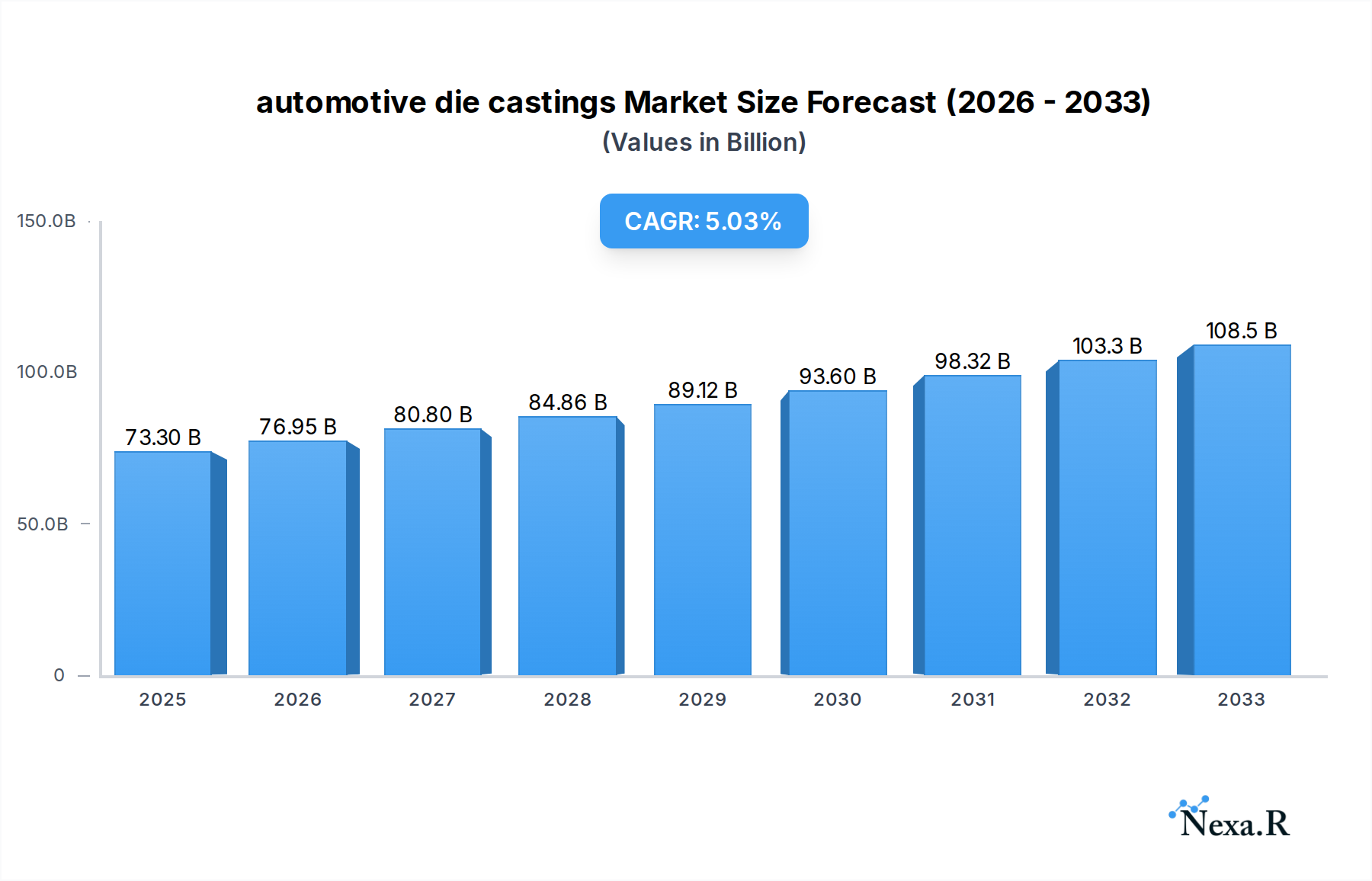
The global automotive die castings market is poised for significant growth, projected to reach a substantial $73.3 billion in 2025. This expansion is driven by the increasing complexity and demand for lightweight, high-performance automotive components. Key market drivers include the escalating production of electric vehicles (EVs), which necessitate specialized die-cast parts for battery enclosures, motor housings, and thermal management systems. Furthermore, stringent government regulations promoting fuel efficiency and reduced emissions are compelling automakers to adopt lighter materials, thereby boosting the demand for aluminum and magnesium die castings. The ongoing trend towards advanced driver-assistance systems (ADAS) and autonomous driving technology also contributes to this growth, as these systems require intricate and precise die-cast components for sensor housings and electronic control units.
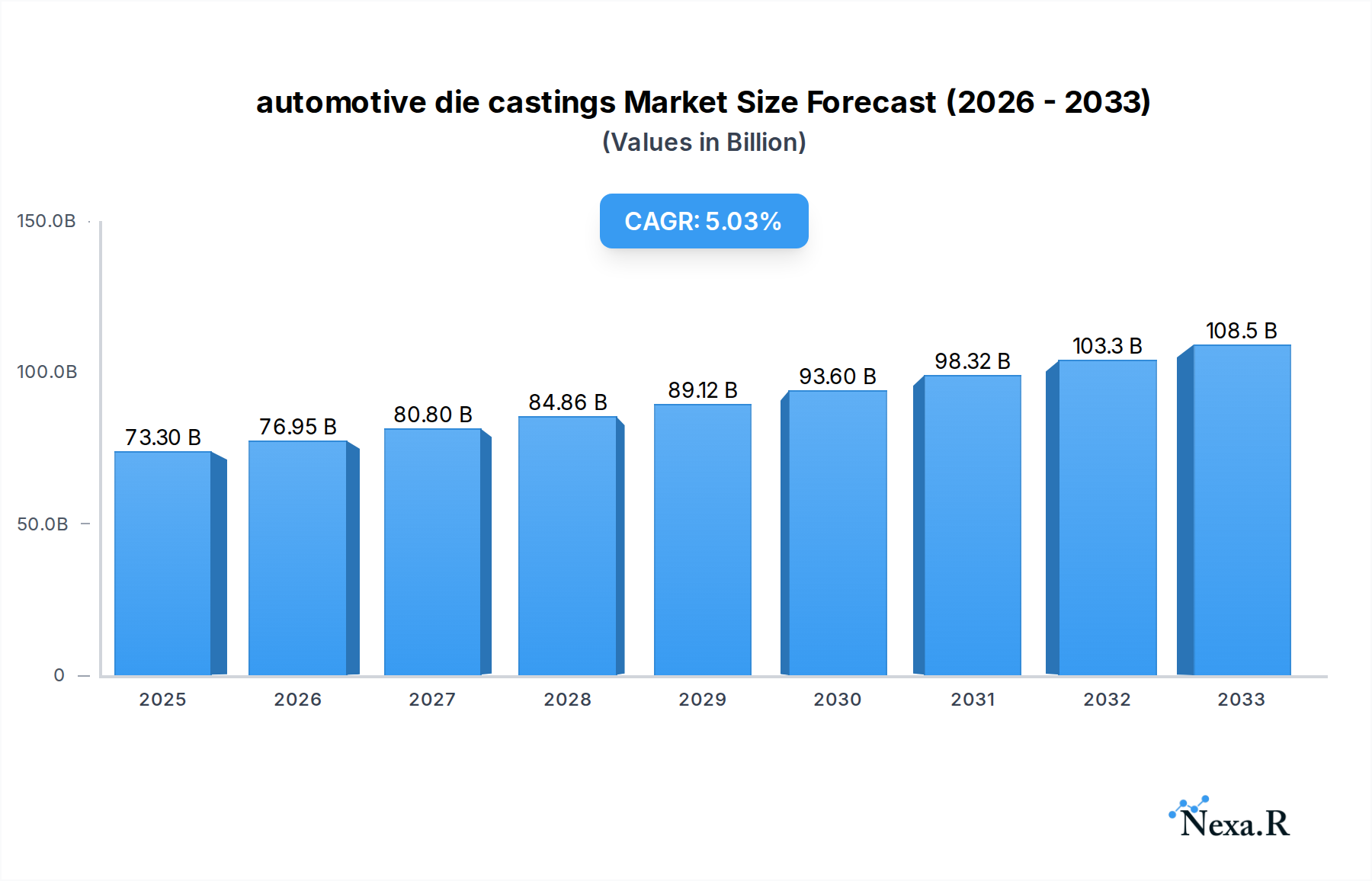
automotive die castings Market Size (In Billion)

The market's compound annual growth rate (CAGR) is estimated at a robust 4.91%, indicating a sustained upward trajectory through the forecast period (2025-2033). This growth is underpinned by technological advancements in die casting processes, such as the adoption of sophisticated automation, simulation software for mold design, and improved surface finishing techniques. These innovations enhance production efficiency, reduce costs, and improve the quality and performance of die-cast parts. While the market benefits from these positive trends, certain restraints exist, including fluctuating raw material prices, particularly for aluminum and zinc, which can impact profitability. Additionally, the initial high investment cost for advanced die casting machinery and the increasing adoption of alternative manufacturing methods like additive manufacturing in specific niche applications could pose challenges. However, the overwhelming demand for lightweight, durable, and cost-effective automotive components in both conventional and electric vehicles solidifies the automotive die castings market's strong growth prospects.
automotive die castings Company Market Share
Comprehensive Automotive Die Castings Market Report: Trends, Opportunities, and Competitive Landscape (2019-2033)
This in-depth report provides an exhaustive analysis of the global automotive die castings market, offering critical insights into market dynamics, growth trajectories, regional dominance, product innovation, key players, and emerging opportunities. Covering the historical period from 2019 to 2024, with a base year of 2025 and a forecast extending to 2033, this report is an indispensable resource for stakeholders seeking to understand and capitalize on the evolving landscape of automotive components manufacturing.
automotive die castings Market Dynamics & Structure
The automotive die castings market is characterized by a moderate to high level of concentration, with a blend of large multinational corporations and specialized regional players. Technological innovation is a primary driver, fueled by the increasing demand for lightweight, durable, and complex automotive parts that enhance fuel efficiency and vehicle performance. Advancements in aluminum die casting and magnesium die casting alloys, coupled with sophisticated casting techniques like high-pressure die casting, are pivotal. Regulatory frameworks, particularly those pertaining to emissions standards and material safety, indirectly influence the adoption of advanced casting technologies and materials. The competitive product substitute landscape includes traditional manufacturing methods and alternative materials, though die casting's cost-effectiveness and precision for high-volume production offer a significant advantage. End-user demographics are shifting towards a younger, technologically inclined consumer base that demands more sophisticated and customizable vehicle features, thereby driving demand for intricate die-cast components. Mergers and acquisitions (M&A) are a recurring trend, as established players consolidate their market positions, acquire new technologies, and expand their global reach. For instance, recent M&A activity has seen significant consolidation within the automotive supplier ecosystem, with companies aiming to bolster their capabilities in engine parts, transmission parts, and body assemblies.
- Market Concentration: A mix of large Tier-1 suppliers and niche manufacturers.
- Technological Innovation: Driven by lightweighting, electrification, and complex part designs.
- Regulatory Frameworks: Influence material choices and manufacturing processes for environmental compliance.
- Competitive Substitutes: Traditional machining, stamping, and advanced composites.
- End-User Demographics: Demand for advanced features and sustainable vehicles.
- M&A Trends: Consolidation for scale, technology acquisition, and market expansion.
automotive die castings Growth Trends & Insights
The automotive die castings market is projected for robust growth, with an estimated market size of $120 billion in 2025, exhibiting a Compound Annual Growth Rate (CAGR) of 6.5% from 2025 to 2033. This expansion is underpinned by the escalating production of vehicles globally, coupled with a significant shift towards lightweighting initiatives aimed at improving fuel economy and reducing carbon emissions. Aluminum die castings are expected to remain the dominant type, accounting for approximately 65% of the market share due to their excellent strength-to-weight ratio and cost-effectiveness. The increasing penetration of electric vehicles (EVs) is a major growth catalyst, as EVs often require a higher proportion of lightweight, complex die-cast components for battery enclosures, motor housings, and chassis parts.
Technological disruptions are continuously reshaping the industry. Advanced simulation and modeling software are optimizing casting designs for reduced material usage and enhanced structural integrity. Additive manufacturing (3D printing) is also beginning to influence prototyping and the production of highly specialized, low-volume components, though high-pressure die casting continues to dominate for mass production.
Consumer behavior shifts are also playing a crucial role. The demand for SUVs and performance vehicles, which often incorporate more complex engine and transmission components, directly benefits the die casting sector. Furthermore, the automotive industry's focus on sustainability is driving the adoption of recyclable aluminum die castings and greener manufacturing processes, aligning with corporate environmental, social, and governance (ESG) goals. The increasing complexity and integration of electronic components in modern vehicles are also creating new opportunities for sophisticated die-cast housings and structural elements.
- Market Size Evolution: Projected to reach approximately $200 billion by 2033.
- Adoption Rates: High adoption due to cost-effectiveness, precision, and scalability.
- Technological Disruptions: Advanced simulation, automation, and emerging additive manufacturing for specialized applications.
- Consumer Behavior Shifts: Demand for lightweighting, performance, and EVs.
- CAGR: 6.5% during the forecast period.
- Market Penetration: Deep penetration across various automotive segments.
Dominant Regions, Countries, or Segments in automotive die castings
The automotive die castings market is witnessing significant growth and dominance across several key regions and product segments, driven by distinct economic policies, infrastructure development, and automotive manufacturing capacities. Asia-Pacific, particularly China, is emerging as the leading region, accounting for an estimated 40% of the global market share in 2025. This dominance is attributed to its status as the world's largest automotive producer and consumer, robust government support for manufacturing, and a rapidly expanding domestic automotive industry, especially in the EV sector.
Within the Application segment, Engine Parts continue to hold a substantial market share, estimated at 35% in 2025, due to their critical role in internal combustion engines and the ongoing demand for advanced engine components. However, Body Assemblies are exhibiting the fastest growth, driven by the increasing use of lightweight aluminum and magnesium alloys in vehicle structures for improved fuel efficiency and safety. The market share for Body Assemblies is projected to grow from 25% in 2025 to 30% by 2033. Transmission Parts also represent a significant segment, estimated at 28% in 2025, as modern transmissions become more complex and require precision-engineered die-cast components.
In terms of Types, Aluminum Die Castings are the undisputed leaders, commanding an estimated 65% of the market share in 2025. Their widespread adoption is due to their exceptional strength-to-weight ratio, corrosion resistance, and recyclability, making them ideal for lightweighting initiatives. Zinc Die Castings follow, accounting for approximately 20%, primarily used for smaller, intricate components requiring excellent surface finish and dimensional accuracy. Magnesium Die Castings are experiencing rapid growth, projected to increase their market share from 12% in 2025 to 15% by 2033, owing to their even lighter weight compared to aluminum, making them increasingly sought after for high-performance and electric vehicles.
- Leading Region: Asia-Pacific (led by China) due to massive automotive production and EV adoption.
- Dominant Application Segment: Engine Parts, with Body Assemblies showing fastest growth.
- Key Driver for Body Assemblies: Lightweighting for fuel efficiency and regulatory compliance.
- Dominant Die Casting Type: Aluminum Die Castings due to superior properties and cost-effectiveness.
- Fastest Growing Die Casting Type: Magnesium Die Castings for extreme lightweighting.
- Growth Potential in Countries: India and Southeast Asian nations are emerging as significant growth markets.
automotive die castings Product Landscape
The automotive die castings product landscape is characterized by a continuous evolution towards lightweight, high-strength, and complex geometries. Innovations focus on the development of advanced alloys, such as high-strength aluminum-silicon-magnesium alloys, that offer superior mechanical properties and corrosion resistance. These materials are instrumental in producing critical components for powertrain, chassis, and structural applications. Die casting processes are being refined to achieve tighter tolerances, improved surface finishes, and the ability to integrate features like cooling channels and mounting points directly into the cast part, reducing post-processing requirements. Unique selling propositions include the cost-effectiveness of high-pressure die casting for mass production, the ability to produce intricate designs with minimal waste, and the inherent recyclability of aluminum and magnesium. Technological advancements are enabling the production of larger, more complex single-piece castings, thereby reducing the number of parts and assembly time in vehicles, particularly for EV components.
Key Drivers, Barriers & Challenges in automotive die castings
The automotive die castings market is propelled by several key drivers. The relentless pursuit of lightweighting in the automotive industry to enhance fuel efficiency and reduce emissions is paramount, directly boosting the demand for aluminum die castings and magnesium die castings. The burgeoning electric vehicle (EV) market is another significant driver, as EVs require specialized, lightweight components for battery management, motor housing, and structural integrity. Technological advancements in casting processes, leading to greater precision, complexity, and material efficiency, also act as strong growth catalysts. Furthermore, the cost-effectiveness and high-volume production capabilities of die casting make it the preferred method for many automotive parts.
However, the market faces several barriers and challenges. Volatility in raw material prices, particularly for aluminum and magnesium, can impact profitability and pricing strategies. The high initial investment required for advanced die casting machinery and tooling can be a significant hurdle for smaller players. Supply chain disruptions, as witnessed in recent years, can affect the availability of raw materials and lead times, impacting production schedules. Stringent environmental regulations regarding emissions and waste management necessitate ongoing investment in cleaner production technologies. Intense competition from alternative manufacturing processes and materials, as well as from low-cost manufacturing regions, also presents a challenge.
- Key Drivers:
- Lightweighting initiatives for fuel efficiency.
- Growth of the Electric Vehicle (EV) market.
- Advancements in casting technology and materials.
- Cost-effectiveness for high-volume production.
- Key Barriers & Challenges:
- Raw material price volatility.
- High initial capital investment for advanced machinery.
- Supply chain disruptions and lead time management.
- Stringent environmental regulations.
- Competition from alternative manufacturing methods.
Emerging Opportunities in automotive die castings
Emerging opportunities in the automotive die castings market are significantly influenced by the ongoing transition towards electrification and advanced vehicle architectures. The increasing demand for integrated thermal management systems in EVs presents a significant opportunity for intricate die-cast components with complex internal cooling channels. The development of smart materials and the integration of sensors directly into die-cast parts for enhanced vehicle diagnostics and autonomous driving capabilities are also promising avenues. Furthermore, the growing trend of vehicle personalization and customization is opening doors for specialized, low-volume production of unique die-cast components. There is also a notable opportunity in developing lighter, more robust die-cast solutions for next-generation battery enclosures and structural components in future mobility concepts, including autonomous shuttles and delivery vehicles.
Growth Accelerators in the automotive die castings Industry
Several factors are acting as growth accelerators for the automotive die castings industry. Technological breakthroughs in alloy development, such as high-entropy alloys and advanced composites integrated with die casting, promise further improvements in performance and weight reduction. Strategic partnerships between die casters, automotive OEMs, and material suppliers are crucial for co-developing innovative solutions tailored to the specific needs of new vehicle platforms. The expansion of advanced manufacturing techniques, including automation, artificial intelligence (AI) for process optimization, and Industry 4.0 integration, will enhance efficiency, quality, and responsiveness. Moreover, a concerted global effort towards developing more sustainable and circular economy principles within the die casting value chain, focusing on increased recyclability and reduced energy consumption, will further solidify its position and appeal.
Key Players Shaping the automotive die castings Market
- Sandhar Group
- Rockman Industries
- Spark Minda Group
- Endurance Technologies Limited
- Rico Auto Industries
- Dynacast
- Rheinmetall Automotive AG
- Nemak
- Mahindra CIE
- Auto Diecasting Company
- Esko Die Casting
- Rane Group
- Bespask Engineers
- Sipra Engineers
- Martinrea Honsel
- Shiloh Industries
- GF Casting Solutions
- Ryobi Die Casting Inc
- Koch Enterprises (Gibbs Die Casting Group)
- Linamar Corporation
- Bocar Group
- Sundaram Clayton Ltd
- Alcast Company
- Kinetic Die Casting Company, Inc.
- Magic Precision, Inc.
- Meridian Lightweight Technologies Inc.
- Mino Industry USA, Inc.
- Eco Die Casting
Notable Milestones in automotive die castings Sector
- 2020: Significant increase in R&D investments focused on lightweight aluminum alloys for EV battery enclosures.
- 2021: Introduction of advanced simulation software optimizing complex die casting designs for structural components.
- 2022: Major acquisitions aimed at expanding global production capacity and technological capabilities in high-pressure die casting.
- 2023: Growing adoption of automation and AI in die casting plants to enhance efficiency and predictive maintenance.
- 2024: Development of novel magnesium alloys offering superior strength and heat resistance for advanced automotive applications.
- 2025: Increased focus on sustainable manufacturing practices and the use of recycled materials in die casting processes.
In-Depth automotive die castings Market Outlook
The automotive die castings market is poised for sustained growth, driven by the global shift towards electric and lightweight vehicles. Key growth accelerators include ongoing technological innovation in alloy development and casting processes, the increasing integration of advanced driver-assistance systems (ADAS) requiring sophisticated component housings, and the broader adoption of sustainable manufacturing practices. Strategic collaborations between industry players and continuous investment in R&D will be critical to capitalize on the evolving demands of the automotive sector. The market's future success will be intricately linked to its ability to deliver lighter, stronger, and more cost-effective solutions that meet stringent environmental regulations and the performance expectations of next-generation vehicles, ensuring its continued relevance and expansion.
automotive die castings Segmentation
-
1. Application
- 1.1. Body Assemblies
- 1.2. Engine Parts
- 1.3. Transmission Parts
- 1.4. Others
-
2. Types
- 2.1. Zinc Die Castings
- 2.2. Aluminum Die Castings
- 2.3. Magnesium Die Castings
- 2.4. Others
automotive die castings Segmentation By Geography
-
1. North America
- 1.1. United States
- 1.2. Canada
- 1.3. Mexico
-
2. South America
- 2.1. Brazil
- 2.2. Argentina
- 2.3. Rest of South America
-
3. Europe
- 3.1. United Kingdom
- 3.2. Germany
- 3.3. France
- 3.4. Italy
- 3.5. Spain
- 3.6. Russia
- 3.7. Benelux
- 3.8. Nordics
- 3.9. Rest of Europe
-
4. Middle East & Africa
- 4.1. Turkey
- 4.2. Israel
- 4.3. GCC
- 4.4. North Africa
- 4.5. South Africa
- 4.6. Rest of Middle East & Africa
-
5. Asia Pacific
- 5.1. China
- 5.2. India
- 5.3. Japan
- 5.4. South Korea
- 5.5. ASEAN
- 5.6. Oceania
- 5.7. Rest of Asia Pacific
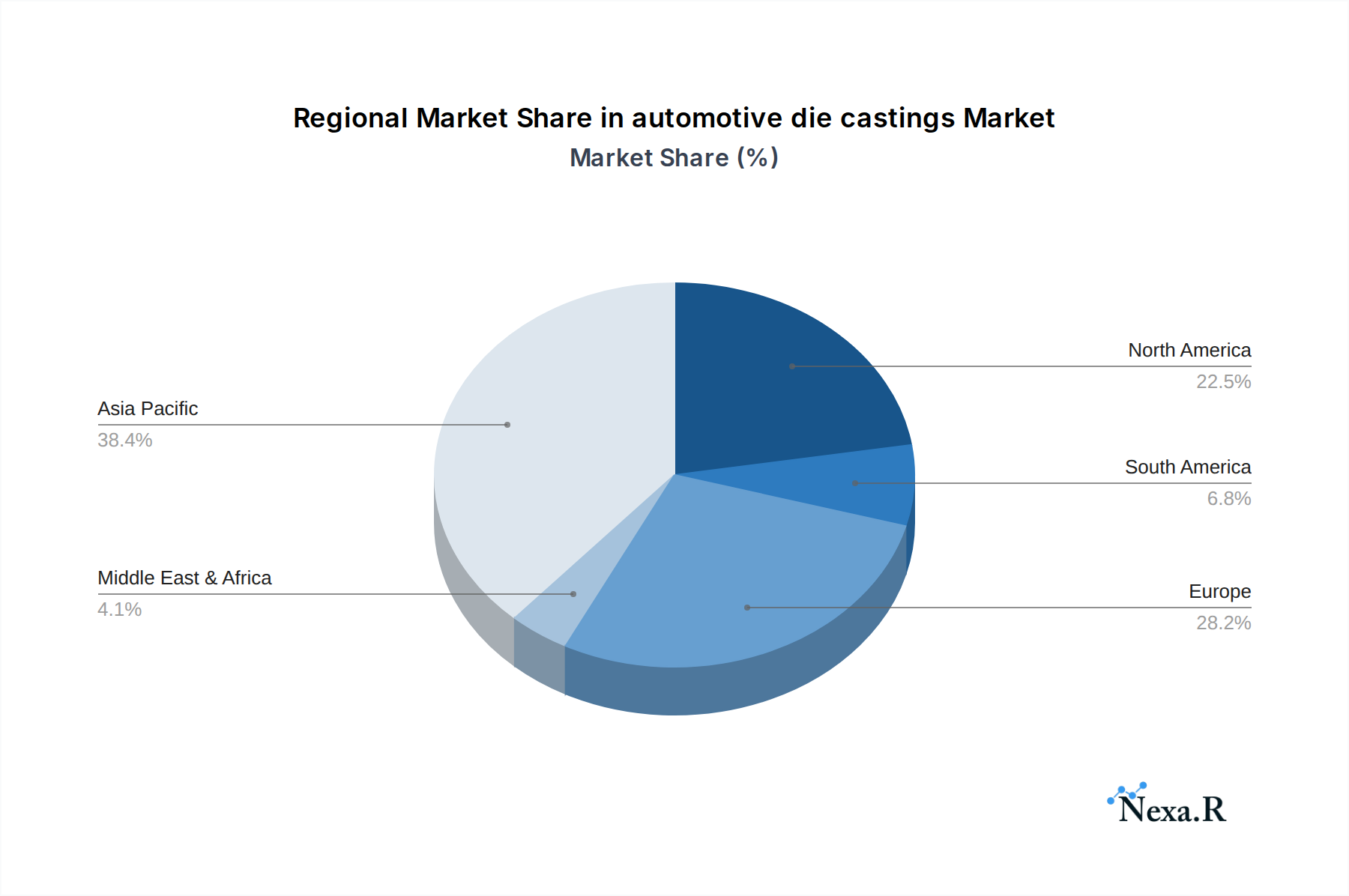
automotive die castings Regional Market Share
Geographic Coverage of automotive die castings
automotive die castings REPORT HIGHLIGHTS
| Aspects | Details |
|---|---|
| Study Period | 2020-2034 |
| Base Year | 2025 |
| Estimated Year | 2026 |
| Forecast Period | 2026-2034 |
| Historical Period | 2020-2025 |
| Growth Rate | CAGR of 4.91% from 2020-2034 |
| Segmentation |
|
Table of Contents
- 1. Introduction
- 1.1. Research Scope
- 1.2. Market Segmentation
- 1.3. Research Methodology
- 1.4. Definitions and Assumptions
- 2. Executive Summary
- 2.1. Introduction
- 3. Market Dynamics
- 3.1. Introduction
- 3.2. Market Drivers
- 3.3. Market Restrains
- 3.4. Market Trends
- 4. Market Factor Analysis
- 4.1. Porters Five Forces
- 4.2. Supply/Value Chain
- 4.3. PESTEL analysis
- 4.4. Market Entropy
- 4.5. Patent/Trademark Analysis
- 5. Global automotive die castings Analysis, Insights and Forecast, 2020-2032
- 5.1. Market Analysis, Insights and Forecast - by Application
- 5.1.1. Body Assemblies
- 5.1.2. Engine Parts
- 5.1.3. Transmission Parts
- 5.1.4. Others
- 5.2. Market Analysis, Insights and Forecast - by Types
- 5.2.1. Zinc Die Castings
- 5.2.2. Aluminum Die Castings
- 5.2.3. Magnesium Die Castings
- 5.2.4. Others
- 5.3. Market Analysis, Insights and Forecast - by Region
- 5.3.1. North America
- 5.3.2. South America
- 5.3.3. Europe
- 5.3.4. Middle East & Africa
- 5.3.5. Asia Pacific
- 5.1. Market Analysis, Insights and Forecast - by Application
- 6. North America automotive die castings Analysis, Insights and Forecast, 2020-2032
- 6.1. Market Analysis, Insights and Forecast - by Application
- 6.1.1. Body Assemblies
- 6.1.2. Engine Parts
- 6.1.3. Transmission Parts
- 6.1.4. Others
- 6.2. Market Analysis, Insights and Forecast - by Types
- 6.2.1. Zinc Die Castings
- 6.2.2. Aluminum Die Castings
- 6.2.3. Magnesium Die Castings
- 6.2.4. Others
- 6.1. Market Analysis, Insights and Forecast - by Application
- 7. South America automotive die castings Analysis, Insights and Forecast, 2020-2032
- 7.1. Market Analysis, Insights and Forecast - by Application
- 7.1.1. Body Assemblies
- 7.1.2. Engine Parts
- 7.1.3. Transmission Parts
- 7.1.4. Others
- 7.2. Market Analysis, Insights and Forecast - by Types
- 7.2.1. Zinc Die Castings
- 7.2.2. Aluminum Die Castings
- 7.2.3. Magnesium Die Castings
- 7.2.4. Others
- 7.1. Market Analysis, Insights and Forecast - by Application
- 8. Europe automotive die castings Analysis, Insights and Forecast, 2020-2032
- 8.1. Market Analysis, Insights and Forecast - by Application
- 8.1.1. Body Assemblies
- 8.1.2. Engine Parts
- 8.1.3. Transmission Parts
- 8.1.4. Others
- 8.2. Market Analysis, Insights and Forecast - by Types
- 8.2.1. Zinc Die Castings
- 8.2.2. Aluminum Die Castings
- 8.2.3. Magnesium Die Castings
- 8.2.4. Others
- 8.1. Market Analysis, Insights and Forecast - by Application
- 9. Middle East & Africa automotive die castings Analysis, Insights and Forecast, 2020-2032
- 9.1. Market Analysis, Insights and Forecast - by Application
- 9.1.1. Body Assemblies
- 9.1.2. Engine Parts
- 9.1.3. Transmission Parts
- 9.1.4. Others
- 9.2. Market Analysis, Insights and Forecast - by Types
- 9.2.1. Zinc Die Castings
- 9.2.2. Aluminum Die Castings
- 9.2.3. Magnesium Die Castings
- 9.2.4. Others
- 9.1. Market Analysis, Insights and Forecast - by Application
- 10. Asia Pacific automotive die castings Analysis, Insights and Forecast, 2020-2032
- 10.1. Market Analysis, Insights and Forecast - by Application
- 10.1.1. Body Assemblies
- 10.1.2. Engine Parts
- 10.1.3. Transmission Parts
- 10.1.4. Others
- 10.2. Market Analysis, Insights and Forecast - by Types
- 10.2.1. Zinc Die Castings
- 10.2.2. Aluminum Die Castings
- 10.2.3. Magnesium Die Castings
- 10.2.4. Others
- 10.1. Market Analysis, Insights and Forecast - by Application
- 11. Competitive Analysis
- 11.1. Global Market Share Analysis 2025
- 11.2. Company Profiles
- 11.2.1 Sandhar Group
- 11.2.1.1. Overview
- 11.2.1.2. Products
- 11.2.1.3. SWOT Analysis
- 11.2.1.4. Recent Developments
- 11.2.1.5. Financials (Based on Availability)
- 11.2.2 Rockman Industries
- 11.2.2.1. Overview
- 11.2.2.2. Products
- 11.2.2.3. SWOT Analysis
- 11.2.2.4. Recent Developments
- 11.2.2.5. Financials (Based on Availability)
- 11.2.3 Spark Minda Group
- 11.2.3.1. Overview
- 11.2.3.2. Products
- 11.2.3.3. SWOT Analysis
- 11.2.3.4. Recent Developments
- 11.2.3.5. Financials (Based on Availability)
- 11.2.4 Endurance Technologies Limited
- 11.2.4.1. Overview
- 11.2.4.2. Products
- 11.2.4.3. SWOT Analysis
- 11.2.4.4. Recent Developments
- 11.2.4.5. Financials (Based on Availability)
- 11.2.5 Rico Auto Industries
- 11.2.5.1. Overview
- 11.2.5.2. Products
- 11.2.5.3. SWOT Analysis
- 11.2.5.4. Recent Developments
- 11.2.5.5. Financials (Based on Availability)
- 11.2.6 Dynacast
- 11.2.6.1. Overview
- 11.2.6.2. Products
- 11.2.6.3. SWOT Analysis
- 11.2.6.4. Recent Developments
- 11.2.6.5. Financials (Based on Availability)
- 11.2.7 Rheinmetall Automotive AG
- 11.2.7.1. Overview
- 11.2.7.2. Products
- 11.2.7.3. SWOT Analysis
- 11.2.7.4. Recent Developments
- 11.2.7.5. Financials (Based on Availability)
- 11.2.8 Nemak
- 11.2.8.1. Overview
- 11.2.8.2. Products
- 11.2.8.3. SWOT Analysis
- 11.2.8.4. Recent Developments
- 11.2.8.5. Financials (Based on Availability)
- 11.2.9 Mahindra CIE
- 11.2.9.1. Overview
- 11.2.9.2. Products
- 11.2.9.3. SWOT Analysis
- 11.2.9.4. Recent Developments
- 11.2.9.5. Financials (Based on Availability)
- 11.2.10 Auto Diecasting Company
- 11.2.10.1. Overview
- 11.2.10.2. Products
- 11.2.10.3. SWOT Analysis
- 11.2.10.4. Recent Developments
- 11.2.10.5. Financials (Based on Availability)
- 11.2.11 Esko Die Casting
- 11.2.11.1. Overview
- 11.2.11.2. Products
- 11.2.11.3. SWOT Analysis
- 11.2.11.4. Recent Developments
- 11.2.11.5. Financials (Based on Availability)
- 11.2.12 Rane Group
- 11.2.12.1. Overview
- 11.2.12.2. Products
- 11.2.12.3. SWOT Analysis
- 11.2.12.4. Recent Developments
- 11.2.12.5. Financials (Based on Availability)
- 11.2.13 Bespask Engineers
- 11.2.13.1. Overview
- 11.2.13.2. Products
- 11.2.13.3. SWOT Analysis
- 11.2.13.4. Recent Developments
- 11.2.13.5. Financials (Based on Availability)
- 11.2.14 Sipra Engineers
- 11.2.14.1. Overview
- 11.2.14.2. Products
- 11.2.14.3. SWOT Analysis
- 11.2.14.4. Recent Developments
- 11.2.14.5. Financials (Based on Availability)
- 11.2.15 Martinrea Honsel
- 11.2.15.1. Overview
- 11.2.15.2. Products
- 11.2.15.3. SWOT Analysis
- 11.2.15.4. Recent Developments
- 11.2.15.5. Financials (Based on Availability)
- 11.2.16 Shiloh Industries
- 11.2.16.1. Overview
- 11.2.16.2. Products
- 11.2.16.3. SWOT Analysis
- 11.2.16.4. Recent Developments
- 11.2.16.5. Financials (Based on Availability)
- 11.2.17 GF Casting Solutions
- 11.2.17.1. Overview
- 11.2.17.2. Products
- 11.2.17.3. SWOT Analysis
- 11.2.17.4. Recent Developments
- 11.2.17.5. Financials (Based on Availability)
- 11.2.18 Ryobi Die Casting Inc
- 11.2.18.1. Overview
- 11.2.18.2. Products
- 11.2.18.3. SWOT Analysis
- 11.2.18.4. Recent Developments
- 11.2.18.5. Financials (Based on Availability)
- 11.2.19 Koch Enterprises (Gibbs Die Casting Group)
- 11.2.19.1. Overview
- 11.2.19.2. Products
- 11.2.19.3. SWOT Analysis
- 11.2.19.4. Recent Developments
- 11.2.19.5. Financials (Based on Availability)
- 11.2.20 Linamar Corporation
- 11.2.20.1. Overview
- 11.2.20.2. Products
- 11.2.20.3. SWOT Analysis
- 11.2.20.4. Recent Developments
- 11.2.20.5. Financials (Based on Availability)
- 11.2.21 Bocar Group
- 11.2.21.1. Overview
- 11.2.21.2. Products
- 11.2.21.3. SWOT Analysis
- 11.2.21.4. Recent Developments
- 11.2.21.5. Financials (Based on Availability)
- 11.2.22 Sundaram Clayton Ltd
- 11.2.22.1. Overview
- 11.2.22.2. Products
- 11.2.22.3. SWOT Analysis
- 11.2.22.4. Recent Developments
- 11.2.22.5. Financials (Based on Availability)
- 11.2.23 Alcast Company
- 11.2.23.1. Overview
- 11.2.23.2. Products
- 11.2.23.3. SWOT Analysis
- 11.2.23.4. Recent Developments
- 11.2.23.5. Financials (Based on Availability)
- 11.2.24 Kinetic Die Casting Company
- 11.2.24.1. Overview
- 11.2.24.2. Products
- 11.2.24.3. SWOT Analysis
- 11.2.24.4. Recent Developments
- 11.2.24.5. Financials (Based on Availability)
- 11.2.25 Inc.
- 11.2.25.1. Overview
- 11.2.25.2. Products
- 11.2.25.3. SWOT Analysis
- 11.2.25.4. Recent Developments
- 11.2.25.5. Financials (Based on Availability)
- 11.2.26 Magic Precision
- 11.2.26.1. Overview
- 11.2.26.2. Products
- 11.2.26.3. SWOT Analysis
- 11.2.26.4. Recent Developments
- 11.2.26.5. Financials (Based on Availability)
- 11.2.27 Inc.
- 11.2.27.1. Overview
- 11.2.27.2. Products
- 11.2.27.3. SWOT Analysis
- 11.2.27.4. Recent Developments
- 11.2.27.5. Financials (Based on Availability)
- 11.2.28 Meridian Lightweight Technologies Inc.
- 11.2.28.1. Overview
- 11.2.28.2. Products
- 11.2.28.3. SWOT Analysis
- 11.2.28.4. Recent Developments
- 11.2.28.5. Financials (Based on Availability)
- 11.2.29 Mino Industry USA
- 11.2.29.1. Overview
- 11.2.29.2. Products
- 11.2.29.3. SWOT Analysis
- 11.2.29.4. Recent Developments
- 11.2.29.5. Financials (Based on Availability)
- 11.2.30 Inc.
- 11.2.30.1. Overview
- 11.2.30.2. Products
- 11.2.30.3. SWOT Analysis
- 11.2.30.4. Recent Developments
- 11.2.30.5. Financials (Based on Availability)
- 11.2.31 Eco Die Casting
- 11.2.31.1. Overview
- 11.2.31.2. Products
- 11.2.31.3. SWOT Analysis
- 11.2.31.4. Recent Developments
- 11.2.31.5. Financials (Based on Availability)
- 11.2.1 Sandhar Group
List of Figures
- Figure 1: Global automotive die castings Revenue Breakdown (undefined, %) by Region 2025 & 2033
- Figure 2: Global automotive die castings Volume Breakdown (K, %) by Region 2025 & 2033
- Figure 3: North America automotive die castings Revenue (undefined), by Application 2025 & 2033
- Figure 4: North America automotive die castings Volume (K), by Application 2025 & 2033
- Figure 5: North America automotive die castings Revenue Share (%), by Application 2025 & 2033
- Figure 6: North America automotive die castings Volume Share (%), by Application 2025 & 2033
- Figure 7: North America automotive die castings Revenue (undefined), by Types 2025 & 2033
- Figure 8: North America automotive die castings Volume (K), by Types 2025 & 2033
- Figure 9: North America automotive die castings Revenue Share (%), by Types 2025 & 2033
- Figure 10: North America automotive die castings Volume Share (%), by Types 2025 & 2033
- Figure 11: North America automotive die castings Revenue (undefined), by Country 2025 & 2033
- Figure 12: North America automotive die castings Volume (K), by Country 2025 & 2033
- Figure 13: North America automotive die castings Revenue Share (%), by Country 2025 & 2033
- Figure 14: North America automotive die castings Volume Share (%), by Country 2025 & 2033
- Figure 15: South America automotive die castings Revenue (undefined), by Application 2025 & 2033
- Figure 16: South America automotive die castings Volume (K), by Application 2025 & 2033
- Figure 17: South America automotive die castings Revenue Share (%), by Application 2025 & 2033
- Figure 18: South America automotive die castings Volume Share (%), by Application 2025 & 2033
- Figure 19: South America automotive die castings Revenue (undefined), by Types 2025 & 2033
- Figure 20: South America automotive die castings Volume (K), by Types 2025 & 2033
- Figure 21: South America automotive die castings Revenue Share (%), by Types 2025 & 2033
- Figure 22: South America automotive die castings Volume Share (%), by Types 2025 & 2033
- Figure 23: South America automotive die castings Revenue (undefined), by Country 2025 & 2033
- Figure 24: South America automotive die castings Volume (K), by Country 2025 & 2033
- Figure 25: South America automotive die castings Revenue Share (%), by Country 2025 & 2033
- Figure 26: South America automotive die castings Volume Share (%), by Country 2025 & 2033
- Figure 27: Europe automotive die castings Revenue (undefined), by Application 2025 & 2033
- Figure 28: Europe automotive die castings Volume (K), by Application 2025 & 2033
- Figure 29: Europe automotive die castings Revenue Share (%), by Application 2025 & 2033
- Figure 30: Europe automotive die castings Volume Share (%), by Application 2025 & 2033
- Figure 31: Europe automotive die castings Revenue (undefined), by Types 2025 & 2033
- Figure 32: Europe automotive die castings Volume (K), by Types 2025 & 2033
- Figure 33: Europe automotive die castings Revenue Share (%), by Types 2025 & 2033
- Figure 34: Europe automotive die castings Volume Share (%), by Types 2025 & 2033
- Figure 35: Europe automotive die castings Revenue (undefined), by Country 2025 & 2033
- Figure 36: Europe automotive die castings Volume (K), by Country 2025 & 2033
- Figure 37: Europe automotive die castings Revenue Share (%), by Country 2025 & 2033
- Figure 38: Europe automotive die castings Volume Share (%), by Country 2025 & 2033
- Figure 39: Middle East & Africa automotive die castings Revenue (undefined), by Application 2025 & 2033
- Figure 40: Middle East & Africa automotive die castings Volume (K), by Application 2025 & 2033
- Figure 41: Middle East & Africa automotive die castings Revenue Share (%), by Application 2025 & 2033
- Figure 42: Middle East & Africa automotive die castings Volume Share (%), by Application 2025 & 2033
- Figure 43: Middle East & Africa automotive die castings Revenue (undefined), by Types 2025 & 2033
- Figure 44: Middle East & Africa automotive die castings Volume (K), by Types 2025 & 2033
- Figure 45: Middle East & Africa automotive die castings Revenue Share (%), by Types 2025 & 2033
- Figure 46: Middle East & Africa automotive die castings Volume Share (%), by Types 2025 & 2033
- Figure 47: Middle East & Africa automotive die castings Revenue (undefined), by Country 2025 & 2033
- Figure 48: Middle East & Africa automotive die castings Volume (K), by Country 2025 & 2033
- Figure 49: Middle East & Africa automotive die castings Revenue Share (%), by Country 2025 & 2033
- Figure 50: Middle East & Africa automotive die castings Volume Share (%), by Country 2025 & 2033
- Figure 51: Asia Pacific automotive die castings Revenue (undefined), by Application 2025 & 2033
- Figure 52: Asia Pacific automotive die castings Volume (K), by Application 2025 & 2033
- Figure 53: Asia Pacific automotive die castings Revenue Share (%), by Application 2025 & 2033
- Figure 54: Asia Pacific automotive die castings Volume Share (%), by Application 2025 & 2033
- Figure 55: Asia Pacific automotive die castings Revenue (undefined), by Types 2025 & 2033
- Figure 56: Asia Pacific automotive die castings Volume (K), by Types 2025 & 2033
- Figure 57: Asia Pacific automotive die castings Revenue Share (%), by Types 2025 & 2033
- Figure 58: Asia Pacific automotive die castings Volume Share (%), by Types 2025 & 2033
- Figure 59: Asia Pacific automotive die castings Revenue (undefined), by Country 2025 & 2033
- Figure 60: Asia Pacific automotive die castings Volume (K), by Country 2025 & 2033
- Figure 61: Asia Pacific automotive die castings Revenue Share (%), by Country 2025 & 2033
- Figure 62: Asia Pacific automotive die castings Volume Share (%), by Country 2025 & 2033
List of Tables
- Table 1: Global automotive die castings Revenue undefined Forecast, by Application 2020 & 2033
- Table 2: Global automotive die castings Volume K Forecast, by Application 2020 & 2033
- Table 3: Global automotive die castings Revenue undefined Forecast, by Types 2020 & 2033
- Table 4: Global automotive die castings Volume K Forecast, by Types 2020 & 2033
- Table 5: Global automotive die castings Revenue undefined Forecast, by Region 2020 & 2033
- Table 6: Global automotive die castings Volume K Forecast, by Region 2020 & 2033
- Table 7: Global automotive die castings Revenue undefined Forecast, by Application 2020 & 2033
- Table 8: Global automotive die castings Volume K Forecast, by Application 2020 & 2033
- Table 9: Global automotive die castings Revenue undefined Forecast, by Types 2020 & 2033
- Table 10: Global automotive die castings Volume K Forecast, by Types 2020 & 2033
- Table 11: Global automotive die castings Revenue undefined Forecast, by Country 2020 & 2033
- Table 12: Global automotive die castings Volume K Forecast, by Country 2020 & 2033
- Table 13: United States automotive die castings Revenue (undefined) Forecast, by Application 2020 & 2033
- Table 14: United States automotive die castings Volume (K) Forecast, by Application 2020 & 2033
- Table 15: Canada automotive die castings Revenue (undefined) Forecast, by Application 2020 & 2033
- Table 16: Canada automotive die castings Volume (K) Forecast, by Application 2020 & 2033
- Table 17: Mexico automotive die castings Revenue (undefined) Forecast, by Application 2020 & 2033
- Table 18: Mexico automotive die castings Volume (K) Forecast, by Application 2020 & 2033
- Table 19: Global automotive die castings Revenue undefined Forecast, by Application 2020 & 2033
- Table 20: Global automotive die castings Volume K Forecast, by Application 2020 & 2033
- Table 21: Global automotive die castings Revenue undefined Forecast, by Types 2020 & 2033
- Table 22: Global automotive die castings Volume K Forecast, by Types 2020 & 2033
- Table 23: Global automotive die castings Revenue undefined Forecast, by Country 2020 & 2033
- Table 24: Global automotive die castings Volume K Forecast, by Country 2020 & 2033
- Table 25: Brazil automotive die castings Revenue (undefined) Forecast, by Application 2020 & 2033
- Table 26: Brazil automotive die castings Volume (K) Forecast, by Application 2020 & 2033
- Table 27: Argentina automotive die castings Revenue (undefined) Forecast, by Application 2020 & 2033
- Table 28: Argentina automotive die castings Volume (K) Forecast, by Application 2020 & 2033
- Table 29: Rest of South America automotive die castings Revenue (undefined) Forecast, by Application 2020 & 2033
- Table 30: Rest of South America automotive die castings Volume (K) Forecast, by Application 2020 & 2033
- Table 31: Global automotive die castings Revenue undefined Forecast, by Application 2020 & 2033
- Table 32: Global automotive die castings Volume K Forecast, by Application 2020 & 2033
- Table 33: Global automotive die castings Revenue undefined Forecast, by Types 2020 & 2033
- Table 34: Global automotive die castings Volume K Forecast, by Types 2020 & 2033
- Table 35: Global automotive die castings Revenue undefined Forecast, by Country 2020 & 2033
- Table 36: Global automotive die castings Volume K Forecast, by Country 2020 & 2033
- Table 37: United Kingdom automotive die castings Revenue (undefined) Forecast, by Application 2020 & 2033
- Table 38: United Kingdom automotive die castings Volume (K) Forecast, by Application 2020 & 2033
- Table 39: Germany automotive die castings Revenue (undefined) Forecast, by Application 2020 & 2033
- Table 40: Germany automotive die castings Volume (K) Forecast, by Application 2020 & 2033
- Table 41: France automotive die castings Revenue (undefined) Forecast, by Application 2020 & 2033
- Table 42: France automotive die castings Volume (K) Forecast, by Application 2020 & 2033
- Table 43: Italy automotive die castings Revenue (undefined) Forecast, by Application 2020 & 2033
- Table 44: Italy automotive die castings Volume (K) Forecast, by Application 2020 & 2033
- Table 45: Spain automotive die castings Revenue (undefined) Forecast, by Application 2020 & 2033
- Table 46: Spain automotive die castings Volume (K) Forecast, by Application 2020 & 2033
- Table 47: Russia automotive die castings Revenue (undefined) Forecast, by Application 2020 & 2033
- Table 48: Russia automotive die castings Volume (K) Forecast, by Application 2020 & 2033
- Table 49: Benelux automotive die castings Revenue (undefined) Forecast, by Application 2020 & 2033
- Table 50: Benelux automotive die castings Volume (K) Forecast, by Application 2020 & 2033
- Table 51: Nordics automotive die castings Revenue (undefined) Forecast, by Application 2020 & 2033
- Table 52: Nordics automotive die castings Volume (K) Forecast, by Application 2020 & 2033
- Table 53: Rest of Europe automotive die castings Revenue (undefined) Forecast, by Application 2020 & 2033
- Table 54: Rest of Europe automotive die castings Volume (K) Forecast, by Application 2020 & 2033
- Table 55: Global automotive die castings Revenue undefined Forecast, by Application 2020 & 2033
- Table 56: Global automotive die castings Volume K Forecast, by Application 2020 & 2033
- Table 57: Global automotive die castings Revenue undefined Forecast, by Types 2020 & 2033
- Table 58: Global automotive die castings Volume K Forecast, by Types 2020 & 2033
- Table 59: Global automotive die castings Revenue undefined Forecast, by Country 2020 & 2033
- Table 60: Global automotive die castings Volume K Forecast, by Country 2020 & 2033
- Table 61: Turkey automotive die castings Revenue (undefined) Forecast, by Application 2020 & 2033
- Table 62: Turkey automotive die castings Volume (K) Forecast, by Application 2020 & 2033
- Table 63: Israel automotive die castings Revenue (undefined) Forecast, by Application 2020 & 2033
- Table 64: Israel automotive die castings Volume (K) Forecast, by Application 2020 & 2033
- Table 65: GCC automotive die castings Revenue (undefined) Forecast, by Application 2020 & 2033
- Table 66: GCC automotive die castings Volume (K) Forecast, by Application 2020 & 2033
- Table 67: North Africa automotive die castings Revenue (undefined) Forecast, by Application 2020 & 2033
- Table 68: North Africa automotive die castings Volume (K) Forecast, by Application 2020 & 2033
- Table 69: South Africa automotive die castings Revenue (undefined) Forecast, by Application 2020 & 2033
- Table 70: South Africa automotive die castings Volume (K) Forecast, by Application 2020 & 2033
- Table 71: Rest of Middle East & Africa automotive die castings Revenue (undefined) Forecast, by Application 2020 & 2033
- Table 72: Rest of Middle East & Africa automotive die castings Volume (K) Forecast, by Application 2020 & 2033
- Table 73: Global automotive die castings Revenue undefined Forecast, by Application 2020 & 2033
- Table 74: Global automotive die castings Volume K Forecast, by Application 2020 & 2033
- Table 75: Global automotive die castings Revenue undefined Forecast, by Types 2020 & 2033
- Table 76: Global automotive die castings Volume K Forecast, by Types 2020 & 2033
- Table 77: Global automotive die castings Revenue undefined Forecast, by Country 2020 & 2033
- Table 78: Global automotive die castings Volume K Forecast, by Country 2020 & 2033
- Table 79: China automotive die castings Revenue (undefined) Forecast, by Application 2020 & 2033
- Table 80: China automotive die castings Volume (K) Forecast, by Application 2020 & 2033
- Table 81: India automotive die castings Revenue (undefined) Forecast, by Application 2020 & 2033
- Table 82: India automotive die castings Volume (K) Forecast, by Application 2020 & 2033
- Table 83: Japan automotive die castings Revenue (undefined) Forecast, by Application 2020 & 2033
- Table 84: Japan automotive die castings Volume (K) Forecast, by Application 2020 & 2033
- Table 85: South Korea automotive die castings Revenue (undefined) Forecast, by Application 2020 & 2033
- Table 86: South Korea automotive die castings Volume (K) Forecast, by Application 2020 & 2033
- Table 87: ASEAN automotive die castings Revenue (undefined) Forecast, by Application 2020 & 2033
- Table 88: ASEAN automotive die castings Volume (K) Forecast, by Application 2020 & 2033
- Table 89: Oceania automotive die castings Revenue (undefined) Forecast, by Application 2020 & 2033
- Table 90: Oceania automotive die castings Volume (K) Forecast, by Application 2020 & 2033
- Table 91: Rest of Asia Pacific automotive die castings Revenue (undefined) Forecast, by Application 2020 & 2033
- Table 92: Rest of Asia Pacific automotive die castings Volume (K) Forecast, by Application 2020 & 2033
Frequently Asked Questions
1. What is the projected Compound Annual Growth Rate (CAGR) of the automotive die castings?
The projected CAGR is approximately 4.91%.
2. Which companies are prominent players in the automotive die castings?
Key companies in the market include Sandhar Group, Rockman Industries, Spark Minda Group, Endurance Technologies Limited, Rico Auto Industries, Dynacast, Rheinmetall Automotive AG, Nemak, Mahindra CIE, Auto Diecasting Company, Esko Die Casting, Rane Group, Bespask Engineers, Sipra Engineers, Martinrea Honsel, Shiloh Industries, GF Casting Solutions, Ryobi Die Casting Inc, Koch Enterprises (Gibbs Die Casting Group), Linamar Corporation, Bocar Group, Sundaram Clayton Ltd, Alcast Company, Kinetic Die Casting Company, Inc., Magic Precision, Inc., Meridian Lightweight Technologies Inc., Mino Industry USA, Inc., Eco Die Casting.
3. What are the main segments of the automotive die castings?
The market segments include Application, Types.
4. Can you provide details about the market size?
The market size is estimated to be USD XXX N/A as of 2022.
5. What are some drivers contributing to market growth?
N/A
6. What are the notable trends driving market growth?
N/A
7. Are there any restraints impacting market growth?
N/A
8. Can you provide examples of recent developments in the market?
N/A
9. What pricing options are available for accessing the report?
Pricing options include single-user, multi-user, and enterprise licenses priced at USD 4350.00, USD 6525.00, and USD 8700.00 respectively.
10. Is the market size provided in terms of value or volume?
The market size is provided in terms of value, measured in N/A and volume, measured in K.
11. Are there any specific market keywords associated with the report?
Yes, the market keyword associated with the report is "automotive die castings," which aids in identifying and referencing the specific market segment covered.
12. How do I determine which pricing option suits my needs best?
The pricing options vary based on user requirements and access needs. Individual users may opt for single-user licenses, while businesses requiring broader access may choose multi-user or enterprise licenses for cost-effective access to the report.
13. Are there any additional resources or data provided in the automotive die castings report?
While the report offers comprehensive insights, it's advisable to review the specific contents or supplementary materials provided to ascertain if additional resources or data are available.
14. How can I stay updated on further developments or reports in the automotive die castings?
To stay informed about further developments, trends, and reports in the automotive die castings, consider subscribing to industry newsletters, following relevant companies and organizations, or regularly checking reputable industry news sources and publications.
Methodology
Step 1 - Identification of Relevant Samples Size from Population Database



Step 2 - Approaches for Defining Global Market Size (Value, Volume* & Price*)

Note*: In applicable scenarios
Step 3 - Data Sources
Primary Research
- Web Analytics
- Survey Reports
- Research Institute
- Latest Research Reports
- Opinion Leaders
Secondary Research
- Annual Reports
- White Paper
- Latest Press Release
- Industry Association
- Paid Database
- Investor Presentations

Step 4 - Data Triangulation
Involves using different sources of information in order to increase the validity of a study
These sources are likely to be stakeholders in a program - participants, other researchers, program staff, other community members, and so on.
Then we put all data in single framework & apply various statistical tools to find out the dynamic on the market.
During the analysis stage, feedback from the stakeholder groups would be compared to determine areas of agreement as well as areas of divergence