


Key Insights
The Industrial Metrology market is poised for significant expansion, propelled by escalating manufacturing automation, stringent quality control mandates, and the integration of AI and machine learning for superior precision. With a projected Compound Annual Growth Rate (CAGR) of 5.9%, the market is anticipated to grow from its 2025 base size of $13.76 billion, reaching substantial future valuations. This upward trajectory is largely attributed to the increasing adoption of high-accuracy 3D metrology solutions, vital for intricate component manufacturing in demanding sectors like aerospace and automotive. The synergy of these systems with advanced software enhances real-time quality assurance and minimizes production disruptions. The hardware segment, including Coordinate Measuring Machines (CMMs), optical digitizers, and X-ray computed tomography, retains a dominant position due to its indispensable role in dimensional verification.
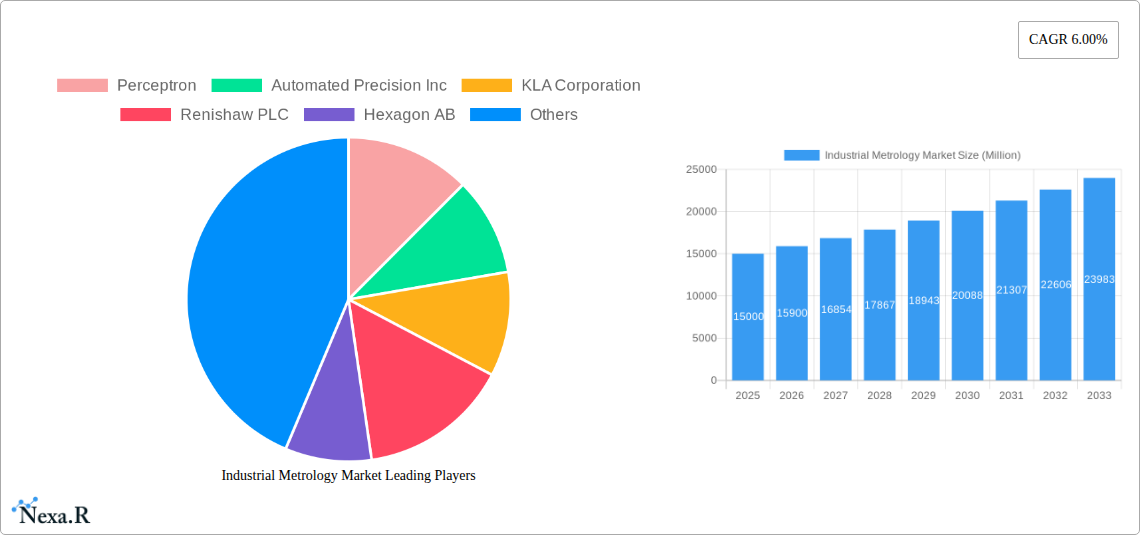
Industrial Metrology Market Market Size (In Billion)

Challenges such as substantial initial capital outlay for advanced equipment and the requirement for specialized expertise in system operation and data interpretation exist. However, continuous innovation, including the development of intuitive software and more accessible metrology solutions, is expected to overcome these obstacles. The Asia Pacific region, led by China and India, presents robust growth prospects fueled by rapid industrialization. North America and Europe will continue to be key markets for sophisticated industrial metrology technologies. Key applications driving market demand include reverse engineering, quality control, and mapping, with automotive and aerospace remaining crucial end-user industries.
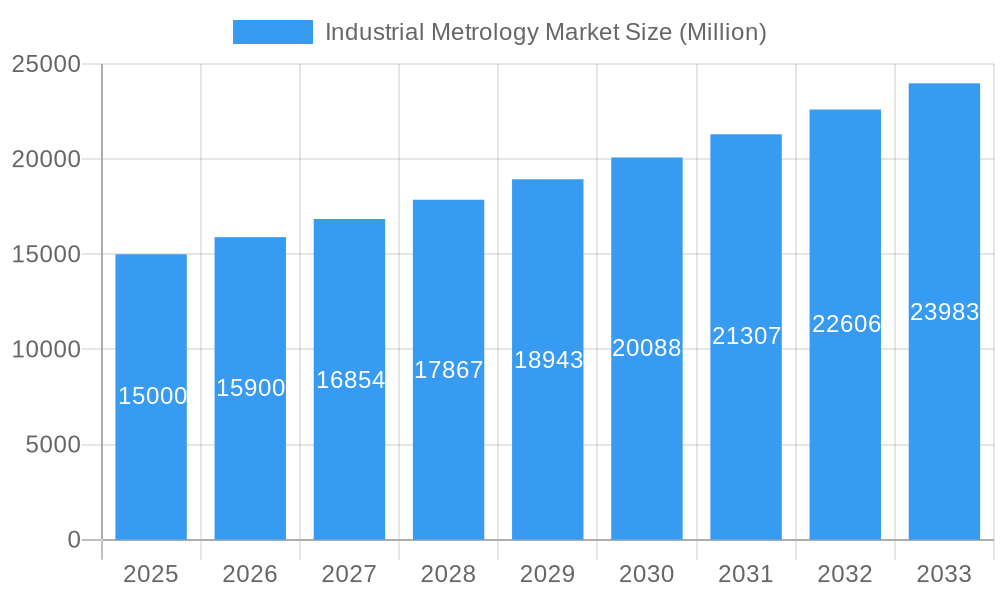
Industrial Metrology Market Company Market Share
Industrial Metrology Market: A Comprehensive Report (2019-2033)
This in-depth report provides a comprehensive analysis of the Industrial Metrology Market, encompassing market dynamics, growth trends, regional dominance, product landscape, key players, and future outlook. The study period spans from 2019 to 2033, with 2025 serving as the base and estimated year. The report segments the market by type (Hardware, Software, Services), equipment (Coordinate Measuring Machine, Optical Digitizer and Scanner, Measuring Instrument, X-Ray and Computed Tomography, Automated Optical Inspection, 2D Equipment), application (Reverse Engineering, Quality Control & Inspection, Mapping and Modelling, Other Applications), and end-user industry (Aerospace and Defense, Automotive, Manufacturing, Semiconductor, Other End User Industries). The market is expected to reach xx Million units by 2033.
Industrial Metrology Market Dynamics & Structure
The Industrial Metrology market is characterized by moderate concentration, with several key players holding significant market share. Technological innovation, particularly in areas like 3D scanning and AI-powered analysis, is a major growth driver. Stringent quality control regulations across various industries fuel demand, while the availability of substitute technologies (e.g., simpler visual inspection methods) presents a challenge. The market is witnessing increasing M&A activity, driven by the need for expanded product portfolios and geographic reach.
- Market Concentration: Moderately concentrated, with top 5 players holding approximately xx% market share in 2025.
- Technological Innovation: Advancements in sensor technology, AI-driven data analysis, and automation are key drivers.
- Regulatory Framework: Stringent quality control standards in industries like aerospace and automotive bolster market growth.
- Competitive Substitutes: Simpler inspection methods present some competitive pressure, but the demand for precise measurements remains strong.
- End-User Demographics: Growth is driven by increasing manufacturing output across various sectors, particularly in developing economies.
- M&A Trends: A steady increase in M&A activity, with an estimated xx deals in the past five years (2019-2024).
Industrial Metrology Market Growth Trends & Insights
The Industrial Metrology market experienced robust growth during the historical period (2019-2024), driven by increasing adoption of advanced manufacturing techniques and stringent quality control requirements. The market size is estimated at xx Million units in 2025 and is projected to grow at a Compound Annual Growth Rate (CAGR) of xx% during the forecast period (2025-2033). This growth is fueled by rising demand from key end-user industries like automotive and semiconductors, and increased adoption of advanced metrology solutions like optical digitizers and automated optical inspection systems. Technological advancements, such as the integration of AI and machine learning, enhance measurement accuracy and efficiency, boosting market penetration. Consumer behavior shifts towards higher precision and automation in manufacturing processes further drive market expansion. Market penetration in emerging economies is expected to increase significantly over the forecast period.
Dominant Regions, Countries, or Segments in Industrial Metrology Market
North America and Europe currently dominate the Industrial Metrology market, driven by established manufacturing bases, stringent quality standards, and high adoption rates of advanced metrology technologies. However, the Asia-Pacific region is experiencing rapid growth, fueled by increasing industrialization and investment in advanced manufacturing.
Dominant Segments:
- By Type: Hardware holds the largest market share, followed by software and services.
- By Equipment: Coordinate Measuring Machines (CMMs) constitute the largest equipment segment, driven by their versatility and accuracy.
- By Application: Quality Control & Inspection is the dominant application, followed by Reverse Engineering.
- By End-User Industry: Automotive and Aerospace & Defense are currently leading end-user industries.
Key Drivers by Region:
- North America: Strong presence of key players, high technological advancements, and stringent regulatory standards.
- Europe: Established manufacturing base, significant investment in R&D, and robust automation initiatives.
- Asia-Pacific: Rapid industrialization, increasing manufacturing output, and favorable government policies.
Industrial Metrology Market Product Landscape
The Industrial Metrology market features a diverse range of products, from traditional Coordinate Measuring Machines (CMMs) to advanced optical scanners and X-ray tomography systems. Recent innovations focus on enhanced accuracy, automation, and integration with data analytics platforms. Products are differentiated by measurement precision, speed, ease of use, and the range of applications they support. Key selling propositions include improved efficiency, reduced operational costs, and enhanced product quality.
Key Drivers, Barriers & Challenges in Industrial Metrology Market
Key Drivers:
- Increasing demand for high-precision measurements across various industries.
- Advancements in sensor technology, AI, and automation.
- Stringent quality control regulations and standards.
- Rising adoption of advanced manufacturing technologies.
Challenges & Restraints:
- High initial investment costs associated with advanced metrology systems.
- Skill gap in operating and maintaining sophisticated equipment.
- The need for specialized expertise in data analysis and interpretation.
- Competition from low-cost providers in emerging markets.
Emerging Opportunities in Industrial Metrology Market
Emerging opportunities lie in the integration of metrology systems with Industry 4.0 technologies, the development of portable and user-friendly metrology solutions, and the expansion into new application areas like additive manufacturing and biomedical engineering. Untapped markets in developing countries offer significant growth potential. The increasing demand for contactless measurement techniques and augmented/virtual reality integration are opening up new possibilities.
Growth Accelerators in the Industrial Metrology Market Industry
Technological advancements in sensor technology, AI-powered data analysis, and cloud-based data management are key growth accelerators. Strategic partnerships and collaborations between metrology providers and end-user industries are driving market expansion. The rising demand for customized metrology solutions tailored to specific industry needs further fuels market growth.
Key Players Shaping the Industrial Metrology Market Market
- Perceptron
- Automated Precision Inc
- KLA Corporation
- Renishaw PLC
- Hexagon AB
- Applied Materials Inc
- Jenoptik AG
- FARO Technologies
- Nikon Metrology
- Carl Zeiss AG
Notable Milestones in Industrial Metrology Market Sector
- August 2022: LK Metrology showcased new CMMs including the LK ALTERA M SCANTEK 5, LK Multi-Sensor ALTERAC, ALTO 65 Bench Top CMM, and COORD 3 UNIVERSAL CMM at a Chicago exhibition. This highlights the ongoing innovation in CMM technology.
- March 2022: Hexagon launched HxGN NC Server, integrating its measurement software with machine tools. This improves data accessibility and workflow efficiency, significantly impacting manufacturing processes.
In-Depth Industrial Metrology Market Market Outlook
The Industrial Metrology market exhibits strong potential for continued growth, driven by technological advancements, increasing automation in manufacturing, and rising demand for precise measurements across various industries. Strategic investments in R&D, expansion into new geographical markets, and the development of innovative products will be crucial factors in realizing this potential. The market is poised for significant growth, particularly in segments related to advanced manufacturing processes, requiring high precision and detailed inspection.
Industrial Metrology Market Segmentation
-
1. Type
- 1.1. Hardware
- 1.2. Software
- 1.3. Services
-
2. Equipment
- 2.1. Coordinate Measuring Machine
- 2.2. Optical Digitizer and Scanner
- 2.3. Measuring Instrument
- 2.4. X-Ray and Computed Tomography
- 2.5. Automated Optical Inspection
- 2.6. 2D Equipment
-
3. Application
- 3.1. Reverse Engineering
- 3.2. Quality Control & Inspection
- 3.3. Mapping and Modelling
- 3.4. Other Applications
-
4. End User Industry
- 4.1. Aerospace and Defense
- 4.2. Automotive
- 4.3. Manufacturing
- 4.4. Semiconductor
- 4.5. Other End User Industries
Industrial Metrology Market Segmentation By Geography
- 1. North America
- 2. Europe
- 3. Asia Pacific
- 4. Rest of the World
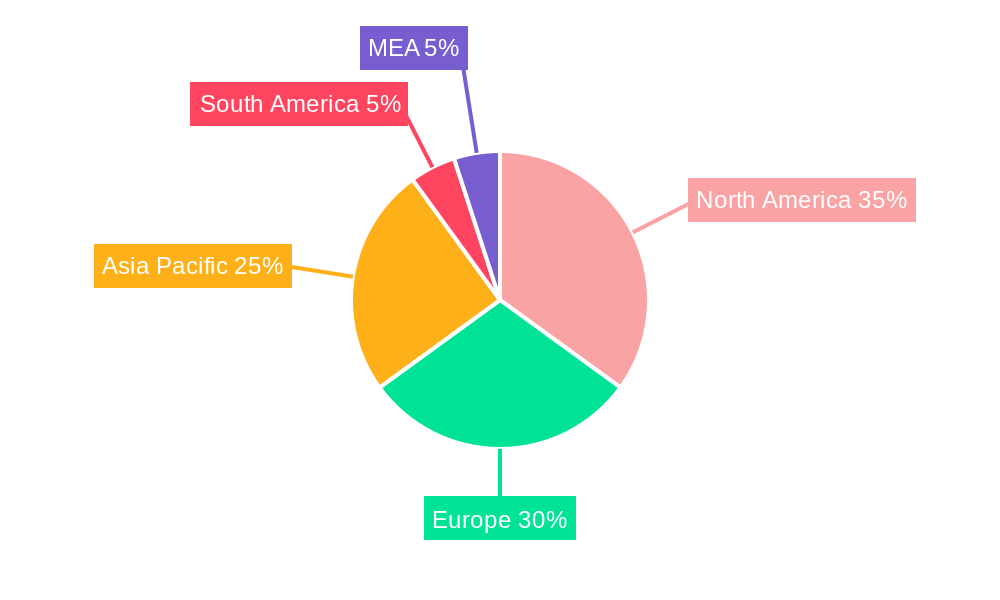
Industrial Metrology Market Regional Market Share
Geographic Coverage of Industrial Metrology Market
Industrial Metrology Market REPORT HIGHLIGHTS
| Aspects | Details |
|---|---|
| Study Period | 2020-2034 |
| Base Year | 2025 |
| Estimated Year | 2026 |
| Forecast Period | 2026-2034 |
| Historical Period | 2020-2025 |
| Growth Rate | CAGR of 5.9% from 2020-2034 |
| Segmentation |
|
Table of Contents
- 1. Introduction
- 1.1. Research Scope
- 1.2. Market Segmentation
- 1.3. Research Methodology
- 1.4. Definitions and Assumptions
- 2. Executive Summary
- 2.1. Introduction
- 3. Market Dynamics
- 3.1. Introduction
- 3.2. Market Drivers
- 3.2.1. Rise in Big Data Analytics; Adoption of Cloud Services to Integrate the Metrological Data; Rising Demand for Automobiles in Developing Countries
- 3.3. Market Restrains
- 3.3.1. High Costs and Operational Concerns; Concerns related to Geoprivacy and Confidential Data
- 3.4. Market Trends
- 3.4.1. Automotive Industry is Expected to Hold the Largest Share
- 4. Market Factor Analysis
- 4.1. Porters Five Forces
- 4.2. Supply/Value Chain
- 4.3. PESTEL analysis
- 4.4. Market Entropy
- 4.5. Patent/Trademark Analysis
- 5. Global Industrial Metrology Market Analysis, Insights and Forecast, 2020-2032
- 5.1. Market Analysis, Insights and Forecast - by Type
- 5.1.1. Hardware
- 5.1.2. Software
- 5.1.3. Services
- 5.2. Market Analysis, Insights and Forecast - by Equipment
- 5.2.1. Coordinate Measuring Machine
- 5.2.2. Optical Digitizer and Scanner
- 5.2.3. Measuring Instrument
- 5.2.4. X-Ray and Computed Tomography
- 5.2.5. Automated Optical Inspection
- 5.2.6. 2D Equipment
- 5.3. Market Analysis, Insights and Forecast - by Application
- 5.3.1. Reverse Engineering
- 5.3.2. Quality Control & Inspection
- 5.3.3. Mapping and Modelling
- 5.3.4. Other Applications
- 5.4. Market Analysis, Insights and Forecast - by End User Industry
- 5.4.1. Aerospace and Defense
- 5.4.2. Automotive
- 5.4.3. Manufacturing
- 5.4.4. Semiconductor
- 5.4.5. Other End User Industries
- 5.5. Market Analysis, Insights and Forecast - by Region
- 5.5.1. North America
- 5.5.2. Europe
- 5.5.3. Asia Pacific
- 5.5.4. Rest of the World
- 5.1. Market Analysis, Insights and Forecast - by Type
- 6. North America Industrial Metrology Market Analysis, Insights and Forecast, 2020-2032
- 6.1. Market Analysis, Insights and Forecast - by Type
- 6.1.1. Hardware
- 6.1.2. Software
- 6.1.3. Services
- 6.2. Market Analysis, Insights and Forecast - by Equipment
- 6.2.1. Coordinate Measuring Machine
- 6.2.2. Optical Digitizer and Scanner
- 6.2.3. Measuring Instrument
- 6.2.4. X-Ray and Computed Tomography
- 6.2.5. Automated Optical Inspection
- 6.2.6. 2D Equipment
- 6.3. Market Analysis, Insights and Forecast - by Application
- 6.3.1. Reverse Engineering
- 6.3.2. Quality Control & Inspection
- 6.3.3. Mapping and Modelling
- 6.3.4. Other Applications
- 6.4. Market Analysis, Insights and Forecast - by End User Industry
- 6.4.1. Aerospace and Defense
- 6.4.2. Automotive
- 6.4.3. Manufacturing
- 6.4.4. Semiconductor
- 6.4.5. Other End User Industries
- 6.1. Market Analysis, Insights and Forecast - by Type
- 7. Europe Industrial Metrology Market Analysis, Insights and Forecast, 2020-2032
- 7.1. Market Analysis, Insights and Forecast - by Type
- 7.1.1. Hardware
- 7.1.2. Software
- 7.1.3. Services
- 7.2. Market Analysis, Insights and Forecast - by Equipment
- 7.2.1. Coordinate Measuring Machine
- 7.2.2. Optical Digitizer and Scanner
- 7.2.3. Measuring Instrument
- 7.2.4. X-Ray and Computed Tomography
- 7.2.5. Automated Optical Inspection
- 7.2.6. 2D Equipment
- 7.3. Market Analysis, Insights and Forecast - by Application
- 7.3.1. Reverse Engineering
- 7.3.2. Quality Control & Inspection
- 7.3.3. Mapping and Modelling
- 7.3.4. Other Applications
- 7.4. Market Analysis, Insights and Forecast - by End User Industry
- 7.4.1. Aerospace and Defense
- 7.4.2. Automotive
- 7.4.3. Manufacturing
- 7.4.4. Semiconductor
- 7.4.5. Other End User Industries
- 7.1. Market Analysis, Insights and Forecast - by Type
- 8. Asia Pacific Industrial Metrology Market Analysis, Insights and Forecast, 2020-2032
- 8.1. Market Analysis, Insights and Forecast - by Type
- 8.1.1. Hardware
- 8.1.2. Software
- 8.1.3. Services
- 8.2. Market Analysis, Insights and Forecast - by Equipment
- 8.2.1. Coordinate Measuring Machine
- 8.2.2. Optical Digitizer and Scanner
- 8.2.3. Measuring Instrument
- 8.2.4. X-Ray and Computed Tomography
- 8.2.5. Automated Optical Inspection
- 8.2.6. 2D Equipment
- 8.3. Market Analysis, Insights and Forecast - by Application
- 8.3.1. Reverse Engineering
- 8.3.2. Quality Control & Inspection
- 8.3.3. Mapping and Modelling
- 8.3.4. Other Applications
- 8.4. Market Analysis, Insights and Forecast - by End User Industry
- 8.4.1. Aerospace and Defense
- 8.4.2. Automotive
- 8.4.3. Manufacturing
- 8.4.4. Semiconductor
- 8.4.5. Other End User Industries
- 8.1. Market Analysis, Insights and Forecast - by Type
- 9. Rest of the World Industrial Metrology Market Analysis, Insights and Forecast, 2020-2032
- 9.1. Market Analysis, Insights and Forecast - by Type
- 9.1.1. Hardware
- 9.1.2. Software
- 9.1.3. Services
- 9.2. Market Analysis, Insights and Forecast - by Equipment
- 9.2.1. Coordinate Measuring Machine
- 9.2.2. Optical Digitizer and Scanner
- 9.2.3. Measuring Instrument
- 9.2.4. X-Ray and Computed Tomography
- 9.2.5. Automated Optical Inspection
- 9.2.6. 2D Equipment
- 9.3. Market Analysis, Insights and Forecast - by Application
- 9.3.1. Reverse Engineering
- 9.3.2. Quality Control & Inspection
- 9.3.3. Mapping and Modelling
- 9.3.4. Other Applications
- 9.4. Market Analysis, Insights and Forecast - by End User Industry
- 9.4.1. Aerospace and Defense
- 9.4.2. Automotive
- 9.4.3. Manufacturing
- 9.4.4. Semiconductor
- 9.4.5. Other End User Industries
- 9.1. Market Analysis, Insights and Forecast - by Type
- 10. Competitive Analysis
- 10.1. Global Market Share Analysis 2025
- 10.2. Company Profiles
- 10.2.1 Perceptron
- 10.2.1.1. Overview
- 10.2.1.2. Products
- 10.2.1.3. SWOT Analysis
- 10.2.1.4. Recent Developments
- 10.2.1.5. Financials (Based on Availability)
- 10.2.2 Automated Precision Inc
- 10.2.2.1. Overview
- 10.2.2.2. Products
- 10.2.2.3. SWOT Analysis
- 10.2.2.4. Recent Developments
- 10.2.2.5. Financials (Based on Availability)
- 10.2.3 KLA Corporation
- 10.2.3.1. Overview
- 10.2.3.2. Products
- 10.2.3.3. SWOT Analysis
- 10.2.3.4. Recent Developments
- 10.2.3.5. Financials (Based on Availability)
- 10.2.4 Renishaw PLC
- 10.2.4.1. Overview
- 10.2.4.2. Products
- 10.2.4.3. SWOT Analysis
- 10.2.4.4. Recent Developments
- 10.2.4.5. Financials (Based on Availability)
- 10.2.5 Hexagon AB
- 10.2.5.1. Overview
- 10.2.5.2. Products
- 10.2.5.3. SWOT Analysis
- 10.2.5.4. Recent Developments
- 10.2.5.5. Financials (Based on Availability)
- 10.2.6 Applied Materials Inc *List Not Exhaustive
- 10.2.6.1. Overview
- 10.2.6.2. Products
- 10.2.6.3. SWOT Analysis
- 10.2.6.4. Recent Developments
- 10.2.6.5. Financials (Based on Availability)
- 10.2.7 Jenoptik AG
- 10.2.7.1. Overview
- 10.2.7.2. Products
- 10.2.7.3. SWOT Analysis
- 10.2.7.4. Recent Developments
- 10.2.7.5. Financials (Based on Availability)
- 10.2.8 FARO Technologies
- 10.2.8.1. Overview
- 10.2.8.2. Products
- 10.2.8.3. SWOT Analysis
- 10.2.8.4. Recent Developments
- 10.2.8.5. Financials (Based on Availability)
- 10.2.9 Nikon Metrology
- 10.2.9.1. Overview
- 10.2.9.2. Products
- 10.2.9.3. SWOT Analysis
- 10.2.9.4. Recent Developments
- 10.2.9.5. Financials (Based on Availability)
- 10.2.10 Carl Zeiss AG
- 10.2.10.1. Overview
- 10.2.10.2. Products
- 10.2.10.3. SWOT Analysis
- 10.2.10.4. Recent Developments
- 10.2.10.5. Financials (Based on Availability)
- 10.2.1 Perceptron
List of Figures
- Figure 1: Global Industrial Metrology Market Revenue Breakdown (billion, %) by Region 2025 & 2033
- Figure 2: North America Industrial Metrology Market Revenue (billion), by Type 2025 & 2033
- Figure 3: North America Industrial Metrology Market Revenue Share (%), by Type 2025 & 2033
- Figure 4: North America Industrial Metrology Market Revenue (billion), by Equipment 2025 & 2033
- Figure 5: North America Industrial Metrology Market Revenue Share (%), by Equipment 2025 & 2033
- Figure 6: North America Industrial Metrology Market Revenue (billion), by Application 2025 & 2033
- Figure 7: North America Industrial Metrology Market Revenue Share (%), by Application 2025 & 2033
- Figure 8: North America Industrial Metrology Market Revenue (billion), by End User Industry 2025 & 2033
- Figure 9: North America Industrial Metrology Market Revenue Share (%), by End User Industry 2025 & 2033
- Figure 10: North America Industrial Metrology Market Revenue (billion), by Country 2025 & 2033
- Figure 11: North America Industrial Metrology Market Revenue Share (%), by Country 2025 & 2033
- Figure 12: Europe Industrial Metrology Market Revenue (billion), by Type 2025 & 2033
- Figure 13: Europe Industrial Metrology Market Revenue Share (%), by Type 2025 & 2033
- Figure 14: Europe Industrial Metrology Market Revenue (billion), by Equipment 2025 & 2033
- Figure 15: Europe Industrial Metrology Market Revenue Share (%), by Equipment 2025 & 2033
- Figure 16: Europe Industrial Metrology Market Revenue (billion), by Application 2025 & 2033
- Figure 17: Europe Industrial Metrology Market Revenue Share (%), by Application 2025 & 2033
- Figure 18: Europe Industrial Metrology Market Revenue (billion), by End User Industry 2025 & 2033
- Figure 19: Europe Industrial Metrology Market Revenue Share (%), by End User Industry 2025 & 2033
- Figure 20: Europe Industrial Metrology Market Revenue (billion), by Country 2025 & 2033
- Figure 21: Europe Industrial Metrology Market Revenue Share (%), by Country 2025 & 2033
- Figure 22: Asia Pacific Industrial Metrology Market Revenue (billion), by Type 2025 & 2033
- Figure 23: Asia Pacific Industrial Metrology Market Revenue Share (%), by Type 2025 & 2033
- Figure 24: Asia Pacific Industrial Metrology Market Revenue (billion), by Equipment 2025 & 2033
- Figure 25: Asia Pacific Industrial Metrology Market Revenue Share (%), by Equipment 2025 & 2033
- Figure 26: Asia Pacific Industrial Metrology Market Revenue (billion), by Application 2025 & 2033
- Figure 27: Asia Pacific Industrial Metrology Market Revenue Share (%), by Application 2025 & 2033
- Figure 28: Asia Pacific Industrial Metrology Market Revenue (billion), by End User Industry 2025 & 2033
- Figure 29: Asia Pacific Industrial Metrology Market Revenue Share (%), by End User Industry 2025 & 2033
- Figure 30: Asia Pacific Industrial Metrology Market Revenue (billion), by Country 2025 & 2033
- Figure 31: Asia Pacific Industrial Metrology Market Revenue Share (%), by Country 2025 & 2033
- Figure 32: Rest of the World Industrial Metrology Market Revenue (billion), by Type 2025 & 2033
- Figure 33: Rest of the World Industrial Metrology Market Revenue Share (%), by Type 2025 & 2033
- Figure 34: Rest of the World Industrial Metrology Market Revenue (billion), by Equipment 2025 & 2033
- Figure 35: Rest of the World Industrial Metrology Market Revenue Share (%), by Equipment 2025 & 2033
- Figure 36: Rest of the World Industrial Metrology Market Revenue (billion), by Application 2025 & 2033
- Figure 37: Rest of the World Industrial Metrology Market Revenue Share (%), by Application 2025 & 2033
- Figure 38: Rest of the World Industrial Metrology Market Revenue (billion), by End User Industry 2025 & 2033
- Figure 39: Rest of the World Industrial Metrology Market Revenue Share (%), by End User Industry 2025 & 2033
- Figure 40: Rest of the World Industrial Metrology Market Revenue (billion), by Country 2025 & 2033
- Figure 41: Rest of the World Industrial Metrology Market Revenue Share (%), by Country 2025 & 2033
List of Tables
- Table 1: Global Industrial Metrology Market Revenue billion Forecast, by Type 2020 & 2033
- Table 2: Global Industrial Metrology Market Revenue billion Forecast, by Equipment 2020 & 2033
- Table 3: Global Industrial Metrology Market Revenue billion Forecast, by Application 2020 & 2033
- Table 4: Global Industrial Metrology Market Revenue billion Forecast, by End User Industry 2020 & 2033
- Table 5: Global Industrial Metrology Market Revenue billion Forecast, by Region 2020 & 2033
- Table 6: Global Industrial Metrology Market Revenue billion Forecast, by Type 2020 & 2033
- Table 7: Global Industrial Metrology Market Revenue billion Forecast, by Equipment 2020 & 2033
- Table 8: Global Industrial Metrology Market Revenue billion Forecast, by Application 2020 & 2033
- Table 9: Global Industrial Metrology Market Revenue billion Forecast, by End User Industry 2020 & 2033
- Table 10: Global Industrial Metrology Market Revenue billion Forecast, by Country 2020 & 2033
- Table 11: Global Industrial Metrology Market Revenue billion Forecast, by Type 2020 & 2033
- Table 12: Global Industrial Metrology Market Revenue billion Forecast, by Equipment 2020 & 2033
- Table 13: Global Industrial Metrology Market Revenue billion Forecast, by Application 2020 & 2033
- Table 14: Global Industrial Metrology Market Revenue billion Forecast, by End User Industry 2020 & 2033
- Table 15: Global Industrial Metrology Market Revenue billion Forecast, by Country 2020 & 2033
- Table 16: Global Industrial Metrology Market Revenue billion Forecast, by Type 2020 & 2033
- Table 17: Global Industrial Metrology Market Revenue billion Forecast, by Equipment 2020 & 2033
- Table 18: Global Industrial Metrology Market Revenue billion Forecast, by Application 2020 & 2033
- Table 19: Global Industrial Metrology Market Revenue billion Forecast, by End User Industry 2020 & 2033
- Table 20: Global Industrial Metrology Market Revenue billion Forecast, by Country 2020 & 2033
- Table 21: Global Industrial Metrology Market Revenue billion Forecast, by Type 2020 & 2033
- Table 22: Global Industrial Metrology Market Revenue billion Forecast, by Equipment 2020 & 2033
- Table 23: Global Industrial Metrology Market Revenue billion Forecast, by Application 2020 & 2033
- Table 24: Global Industrial Metrology Market Revenue billion Forecast, by End User Industry 2020 & 2033
- Table 25: Global Industrial Metrology Market Revenue billion Forecast, by Country 2020 & 2033
Frequently Asked Questions
1. What is the projected Compound Annual Growth Rate (CAGR) of the Industrial Metrology Market?
The projected CAGR is approximately 5.9%.
2. Which companies are prominent players in the Industrial Metrology Market?
Key companies in the market include Perceptron, Automated Precision Inc, KLA Corporation, Renishaw PLC, Hexagon AB, Applied Materials Inc *List Not Exhaustive, Jenoptik AG, FARO Technologies, Nikon Metrology, Carl Zeiss AG.
3. What are the main segments of the Industrial Metrology Market?
The market segments include Type, Equipment, Application, End User Industry.
4. Can you provide details about the market size?
The market size is estimated to be USD 13.76 billion as of 2022.
5. What are some drivers contributing to market growth?
Rise in Big Data Analytics; Adoption of Cloud Services to Integrate the Metrological Data; Rising Demand for Automobiles in Developing Countries.
6. What are the notable trends driving market growth?
Automotive Industry is Expected to Hold the Largest Share.
7. Are there any restraints impacting market growth?
High Costs and Operational Concerns; Concerns related to Geoprivacy and Confidential Data.
8. Can you provide examples of recent developments in the market?
August 2022 - LK Metrology, manufacturer of Coordinate Measuring Machines (CMMs), metrology software, and associated CMM accessory products announced to exhibit various new products in Booth No. 135230 in Chicago. Four different CMMs will be demonstrated, including the LK ALTERA M SCANTEK 5 equipped with a Renishaw REVO-2 5-axis scanning system; the LK Multi-Sensor ALTERAC equipped with LK's new blue line laser scanner, and a new surface roughness probe; the new ALTO 65 Bench Top CMM; and, a new COORD 3 UNIVERSAL CMM.
9. What pricing options are available for accessing the report?
Pricing options include single-user, multi-user, and enterprise licenses priced at USD 4750, USD 5250, and USD 8750 respectively.
10. Is the market size provided in terms of value or volume?
The market size is provided in terms of value, measured in billion.
11. Are there any specific market keywords associated with the report?
Yes, the market keyword associated with the report is "Industrial Metrology Market," which aids in identifying and referencing the specific market segment covered.
12. How do I determine which pricing option suits my needs best?
The pricing options vary based on user requirements and access needs. Individual users may opt for single-user licenses, while businesses requiring broader access may choose multi-user or enterprise licenses for cost-effective access to the report.
13. Are there any additional resources or data provided in the Industrial Metrology Market report?
While the report offers comprehensive insights, it's advisable to review the specific contents or supplementary materials provided to ascertain if additional resources or data are available.
14. How can I stay updated on further developments or reports in the Industrial Metrology Market?
To stay informed about further developments, trends, and reports in the Industrial Metrology Market, consider subscribing to industry newsletters, following relevant companies and organizations, or regularly checking reputable industry news sources and publications.
Methodology
Step 1 - Identification of Relevant Samples Size from Population Database



Step 2 - Approaches for Defining Global Market Size (Value, Volume* & Price*)

Note*: In applicable scenarios
Step 3 - Data Sources
Primary Research
- Web Analytics
- Survey Reports
- Research Institute
- Latest Research Reports
- Opinion Leaders
Secondary Research
- Annual Reports
- White Paper
- Latest Press Release
- Industry Association
- Paid Database
- Investor Presentations

Step 4 - Data Triangulation
Involves using different sources of information in order to increase the validity of a study
These sources are likely to be stakeholders in a program - participants, other researchers, program staff, other community members, and so on.
Then we put all data in single framework & apply various statistical tools to find out the dynamic on the market.
During the analysis stage, feedback from the stakeholder groups would be compared to determine areas of agreement as well as areas of divergence