


Key Insights
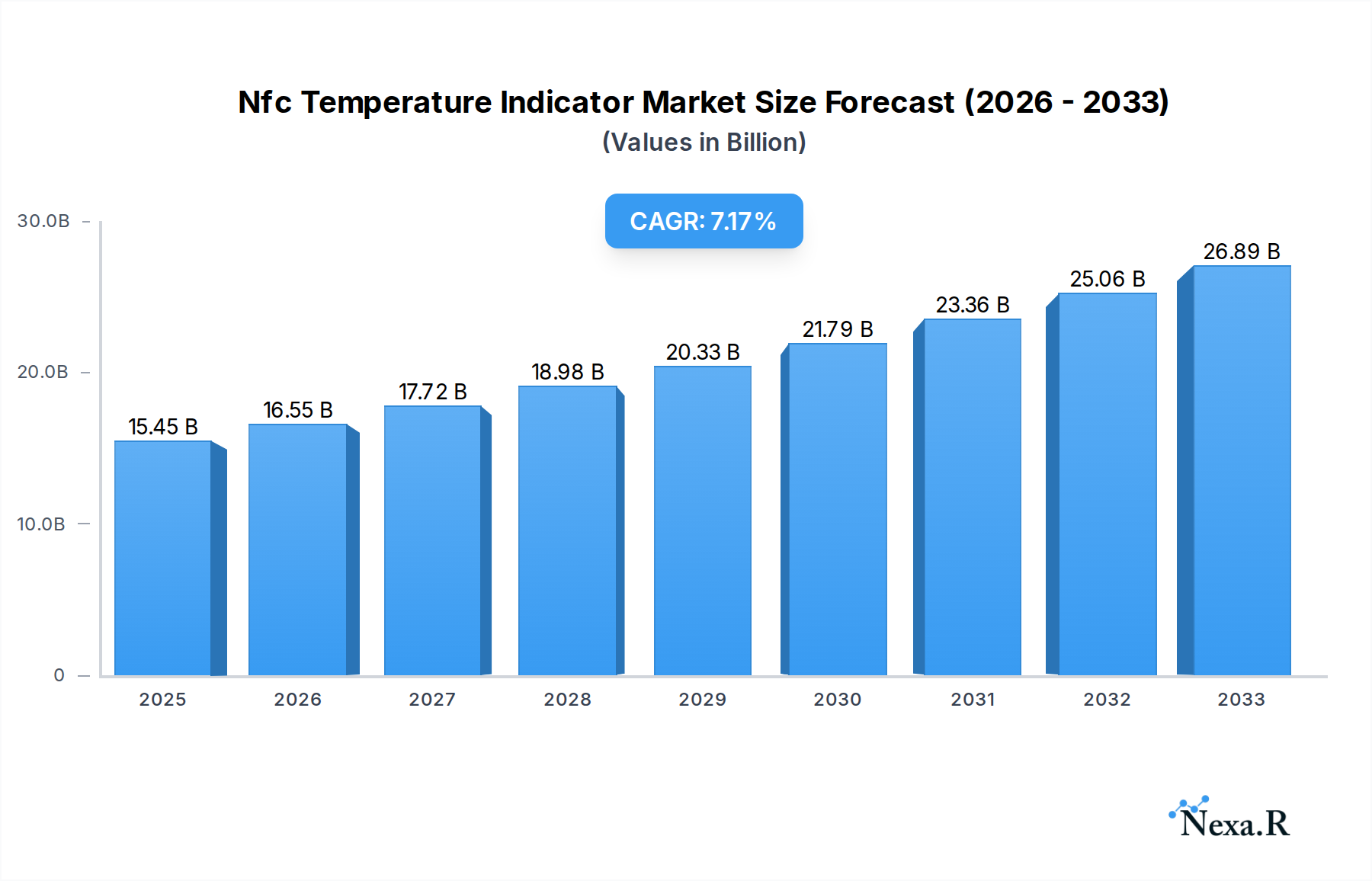
The NFC temperature indicator market is poised for significant growth, driven by increasing demand for real-time temperature monitoring across critical sectors like pharmaceuticals, vaccines, and food distribution. With a projected market size of $15.45 billion in 2025, and a robust CAGR of 7.16%, this sector is set to expand substantially through 2033. Key drivers fueling this expansion include the stringent regulatory requirements for maintaining cold chain integrity, the growing consumer awareness regarding food safety, and the technological advancements in NFC (Near Field Communication) capabilities, offering cost-effective, reliable, and user-friendly temperature logging solutions. The shift towards single-use indicators for enhanced sterility and traceability, particularly in medical applications, alongside the development of reusable indicators for broader industrial uses, represents a key segmentation trend. The inherent benefits of NFC technology – contactless data retrieval and immediate status updates – are revolutionizing how sensitive goods are managed throughout their supply chains, mitigating risks of spoilage and ensuring product efficacy.
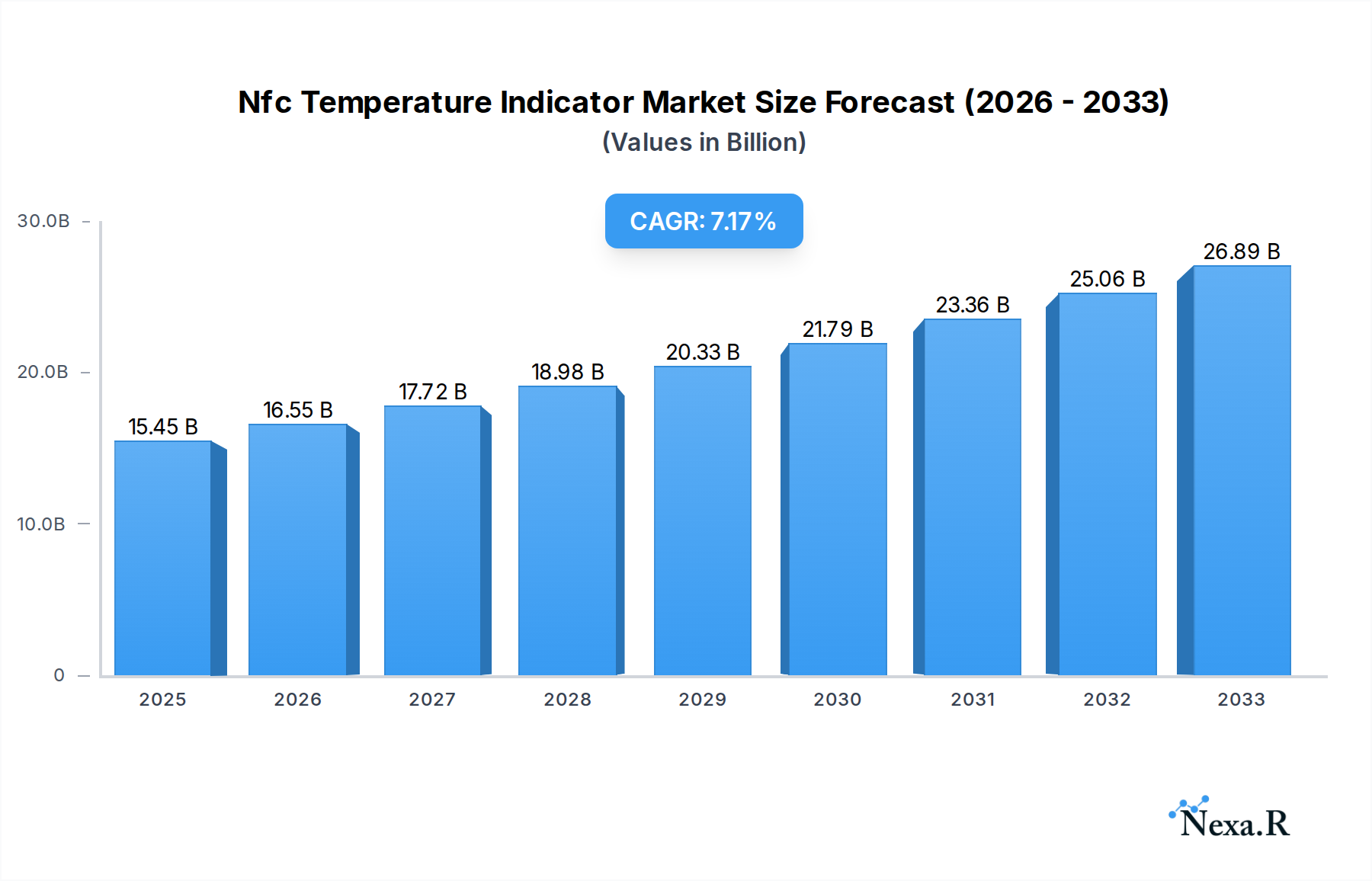
Nfc Temperature Indicator Market Size (In Billion)

Geographically, North America and Europe are expected to lead the market, owing to well-established cold chain infrastructure and stringent quality control mandates. However, the Asia Pacific region, particularly China and India, is anticipated to witness the fastest growth, fueled by rapid industrialization, increasing disposable incomes, and a growing focus on public health initiatives that necessitate advanced temperature monitoring. Emerging applications in the laboratory and flower industries, though smaller in current market share, present significant future growth potential as awareness and adoption rates increase. The market faces some restraints, including the initial implementation costs for some advanced systems and the need for widespread NFC reader adoption across all supply chain touchpoints. Nevertheless, the overarching benefits of enhanced product safety, reduced waste, and improved supply chain efficiency are expected to outweigh these challenges, solidifying the NFC temperature indicator market's upward trajectory.
Nfc Temperature Indicator Company Market Share
NFC Temperature Indicator Market Report: Comprehensive Analysis and Future Outlook
This in-depth market research report provides a detailed analysis of the global NFC Temperature Indicator market, encompassing its current dynamics, growth trajectory, and future potential. Leveraging cutting-edge research methodologies and extensive data analysis, this report offers actionable insights for stakeholders across the supply chain, from manufacturers and distributors to end-users and investors. The report covers the study period from 2019–2033, with a base year of 2025, an estimated year of 2025, and a forecast period of 2025–2033, alongside historical data from 2019–2024.
NFC Temperature Indicator Market Dynamics & Structure
The NFC Temperature Indicator market is characterized by a moderately consolidated structure, with key players like DeltaTrak, Sensitech, and Elitech holding significant market share. Technological innovation is a primary driver, with advancements in NFC chip technology, sensor accuracy, and data logging capabilities continuously enhancing product performance and expanding application scope. Regulatory frameworks, particularly within the pharmaceutical and food industries, mandate stringent temperature monitoring, fostering demand for reliable NFC temperature indicators. Competitive product substitutes, such as traditional temperature loggers and manual recording methods, are gradually being phased out due to the enhanced efficiency and traceability offered by NFC solutions. End-user demographics are shifting towards a greater demand for real-time data, remote monitoring, and supply chain visibility, particularly from industries dealing with temperature-sensitive goods. Mergers and acquisitions (M&A) trends, while not rampant, indicate strategic moves by larger companies to acquire innovative technologies or expand their market reach, with an estimated X billion in M&A deal volumes observed over the historical period. Barriers to innovation include the high cost of initial R&D for advanced features and the need for robust cybersecurity measures to protect sensitive data.
- Market Concentration: Moderately consolidated with key players dominating.
- Technological Innovation Drivers: Miniaturization of NFC chips, improved sensor accuracy, enhanced battery life, cloud integration.
- Regulatory Frameworks: Stringent requirements for cold chain monitoring in pharmaceuticals and food.
- Competitive Product Substitutes: Traditional loggers, manual recording.
- End-User Demographics: Growing demand for real-time data, remote monitoring, supply chain transparency.
- M&A Trends: Strategic acquisitions for technology and market expansion.
- Innovation Barriers: High R&D costs, cybersecurity concerns.
NFC Temperature Indicator Growth Trends & Insights
The global NFC Temperature Indicator market is projected to witness robust growth, driven by the escalating demand for enhanced cold chain management and the increasing stringency of regulations governing the transportation of temperature-sensitive goods. The market size is estimated to reach XX billion by the end of the forecast period, exhibiting a Compound Annual Growth Rate (CAGR) of XX% from 2025 to 2033. Adoption rates are steadily increasing across diverse sectors, particularly within the Medicine, Vaccine, and Blood segments, where maintaining precise temperature conditions is critical for product efficacy and safety. Technological disruptions, such as the integration of IoT capabilities and advanced data analytics platforms, are further accelerating market penetration by offering predictive insights and proactive alerts. Consumer behavior shifts are leaning towards a preference for solutions that provide irrefutable proof of temperature integrity throughout the supply chain, thereby reducing product spoilage and waste. The market penetration is expected to cross XX% by 2033, indicating a significant shift from traditional monitoring methods.
The growing awareness of product spoilage and its economic implications is a primary catalyst for the adoption of NFC temperature indicators. In the pharmaceutical industry, the integrity of vaccines and biological drugs is paramount, and any deviation from recommended temperature ranges can render them ineffective or even harmful. Similarly, the food industry faces substantial losses due to spoilage during transit and storage, making accurate temperature monitoring a crucial requirement. The Laboratory segment also benefits from these indicators, ensuring the integrity of samples and reagents. The Flower segment, though smaller, is also experiencing increased adoption due to the perishable nature of its products.
Furthermore, the development of reusable NFC temperature indicators is gaining traction, offering a cost-effective and sustainable alternative to single-use solutions, particularly for frequent shipments or internal logistics. This trend is contributing to market expansion and encouraging wider adoption, especially among small and medium-sized enterprises. The continuous evolution of NFC technology, including increased read range, faster data transfer speeds, and enhanced tamper-evident features, is enhancing the value proposition of these indicators. The base year market size is projected to be XX billion in 2025.
Dominant Regions, Countries, or Segments in NFC Temperature Indicator
The Medicine and Vaccine application segment is a dominant force within the global NFC Temperature Indicator market, driven by the critical need for unwavering temperature control throughout the pharmaceutical cold chain. This dominance is further amplified by rigorous regulatory mandates from bodies like the FDA and EMA, which necessitate comprehensive temperature monitoring for the safe and effective distribution of life-saving medications and vaccines. The market share for this segment is estimated to be XX% of the total market in 2025, with projected growth to XX% by 2033. Key drivers for this segment’s supremacy include the increasing global demand for advanced healthcare solutions, the rapid development of new temperature-sensitive biologics, and the continuous expansion of vaccination programs worldwide.
North America, particularly the United States, emerges as the leading region due to its well-established pharmaceutical manufacturing base, advanced healthcare infrastructure, and high adoption rates of cutting-edge technologies. The country’s stringent regulatory environment and proactive approach to supply chain integrity significantly contribute to the demand for sophisticated temperature monitoring solutions. Market share in North America is projected to be XX% by 2025, with a steady growth rate.
Within the Type segmentation, Single-Use NFC temperature indicators, while currently holding a significant market share due to their simplicity and immediate deployment, are witnessing a growing challenge from Reusable alternatives. Reusable indicators offer a compelling economic advantage for high-volume users and contribute to sustainability efforts, leading to an anticipated increase in their market penetration.
The global NFC Temperature Indicator market is also influenced by supportive economic policies that encourage technological adoption and supply chain modernization. Infrastructure development, particularly in logistics and cold storage facilities, further underpins the growth of this market by ensuring the effective deployment of temperature monitoring solutions across vast geographical areas.
- Dominant Application Segment: Medicine & Vaccine (estimated market share XX% in 2025).
- Leading Region: North America (projected market share XX% in 2025).
- Key Drivers in Medicine/Vaccine: Regulatory mandates, growing demand for biologics, global vaccination efforts.
- Dominant Country: United States.
- Economic Policies: Supportive of technological adoption and supply chain upgrades.
- Infrastructure: Advanced logistics and cold storage networks.
- Type Trend: Growing adoption of Reusable indicators alongside Single-Use.
NFC Temperature Indicator Product Landscape
The NFC Temperature Indicator product landscape is characterized by continuous innovation, focusing on enhanced accuracy, expanded data logging capabilities, and user-friendly interfaces. Products are increasingly incorporating advanced NFC chips for faster data retrieval and broader compatibility with smartphones and dedicated readers. Innovations include multi-point temperature monitoring within a single device, extended battery life for longer supply chains, and integrated alert systems that notify stakeholders of any temperature excursions in real-time. Unique selling propositions often revolve around tamper-evident features, cloud connectivity for seamless data integration, and compliance with international standards like GDP (Good Distribution Practice). Technological advancements are also leading to miniaturization, making indicators more discreet and suitable for a wider range of applications, from individual vials to pallet-level monitoring. The estimated market value for these advanced products in 2025 stands at XX billion.
Key Drivers, Barriers & Challenges in NFC Temperature Indicator
Key Drivers: The NFC Temperature Indicator market is propelled by several critical factors. The stringent regulatory compliance requirements across industries such as pharmaceuticals, food, and blood transportation are paramount. The escalating demand for real-time temperature monitoring and enhanced supply chain visibility directly fuels adoption. Technological advancements in NFC and sensor technology, leading to more accurate, reliable, and cost-effective solutions, are significant drivers. Furthermore, the growing awareness of the economic losses associated with spoilage of temperature-sensitive goods incentivizes investment in advanced monitoring.
- Regulatory mandates for cold chain integrity.
- Demand for real-time data and supply chain transparency.
- Advancements in NFC and sensor technology.
- Economic impact of product spoilage reduction.
Barriers & Challenges: Despite the promising outlook, the market faces certain challenges. The initial cost of implementing advanced NFC temperature monitoring systems can be a barrier, especially for smaller enterprises. Interoperability issues between different NFC readers and software platforms can hinder seamless integration. Ensuring robust cybersecurity to protect sensitive temperature data is a continuous concern. Moreover, the availability of skilled personnel to effectively manage and interpret the data generated by these systems can be limited in some regions. Supply chain disruptions, as witnessed globally, can also impact the timely delivery of components and finished products.
- High initial implementation costs.
- Interoperability challenges.
- Cybersecurity concerns for data protection.
- Shortage of skilled personnel.
- Supply chain disruptions.
Emerging Opportunities in NFC Temperature Indicator
Emerging opportunities in the NFC Temperature Indicator sector lie in the untapped potential of nascent markets and the development of innovative applications. The expanding cold chain infrastructure in developing economies presents a significant growth avenue. Furthermore, the integration of NFC temperature indicators with blockchain technology promises enhanced traceability and immutable record-keeping, addressing critical needs in counterfeit detection and product authenticity verification. Evolving consumer preferences for sustainable and transparent supply chains are also creating opportunities for eco-friendly and data-rich monitoring solutions. The increasing focus on precision agriculture for temperature-sensitive crops and the burgeoning e-commerce of perishable goods will also drive demand for specialized NFC temperature indicators.
Growth Accelerators in the NFC Temperature Indicator Industry
Several catalysts are driving long-term growth in the NFC Temperature Indicator industry. Technological breakthroughs in miniaturization and power efficiency of NFC chips are enabling smaller, more discreet, and longer-lasting indicators. Strategic partnerships between NFC technology providers, sensor manufacturers, and logistics companies are creating integrated end-to-end solutions, enhancing market reach and adoption. The increasing adoption of IoT platforms and cloud-based data analytics is transforming temperature indicators from mere data loggers into intelligent monitoring systems, offering predictive insights and proactive risk management. Market expansion strategies, including targeting niche applications and developing customized solutions for specific industry needs, are also contributing to sustained growth.
Key Players Shaping the NFC Temperature Indicator Market
- DeltaTrak
- Sensitech
- Elitech
- NOVUS Automation
- Thermolabo
- Graphic Controls
- Xylem
- CCL Healthcare
- Freshliance Electronics
- Tive
- Shenzhen Jumaoyuan Science And Technology
Notable Milestones in NFC Temperature Indicator Sector
- 2019: Launch of advanced, multi-use NFC temperature indicators with enhanced data storage capacity.
- 2020: Increased adoption of NFC temperature indicators for vaccine distribution amidst global health initiatives.
- 2021: Development of tamper-evident NFC temperature tags with integrated security features.
- 2022: Emergence of cloud-connected NFC temperature monitoring solutions offering real-time alerts and analytics.
- 2023: Focus on developing eco-friendly and reusable NFC temperature indicators to meet sustainability demands.
- 2024: Integration of NFC temperature indicators with blockchain technology for enhanced supply chain traceability.
In-Depth NFC Temperature Indicator Market Outlook
The NFC Temperature Indicator market is poised for significant expansion, driven by an confluence of technological advancements, stringent regulatory demands, and a growing emphasis on supply chain integrity. Growth accelerators, including the miniaturization of NFC technology, strategic industry partnerships, and the widespread adoption of IoT and AI-powered analytics, will fuel sustained momentum. Future market potential is immense, particularly in emerging economies and niche applications like precision agriculture and specialized healthcare logistics. Strategic opportunities lie in developing highly customized solutions, enhancing cybersecurity protocols, and fostering interoperability across diverse platforms to cater to the evolving needs of a globalized and increasingly regulated marketplace. The market is projected to reach XX billion by 2033.
Nfc Temperature Indicator Segmentation
-
1. Application
- 1.1. Medicine
- 1.2. Vaccine
- 1.3. Blood
- 1.4. Food
- 1.5. Flower
- 1.6. Laboratory
- 1.7. Others
-
2. Type
- 2.1. Reusable
- 2.2. Single-Use
Nfc Temperature Indicator Segmentation By Geography
-
1. North America
- 1.1. United States
- 1.2. Canada
- 1.3. Mexico
-
2. South America
- 2.1. Brazil
- 2.2. Argentina
- 2.3. Rest of South America
-
3. Europe
- 3.1. United Kingdom
- 3.2. Germany
- 3.3. France
- 3.4. Italy
- 3.5. Spain
- 3.6. Russia
- 3.7. Benelux
- 3.8. Nordics
- 3.9. Rest of Europe
-
4. Middle East & Africa
- 4.1. Turkey
- 4.2. Israel
- 4.3. GCC
- 4.4. North Africa
- 4.5. South Africa
- 4.6. Rest of Middle East & Africa
-
5. Asia Pacific
- 5.1. China
- 5.2. India
- 5.3. Japan
- 5.4. South Korea
- 5.5. ASEAN
- 5.6. Oceania
- 5.7. Rest of Asia Pacific
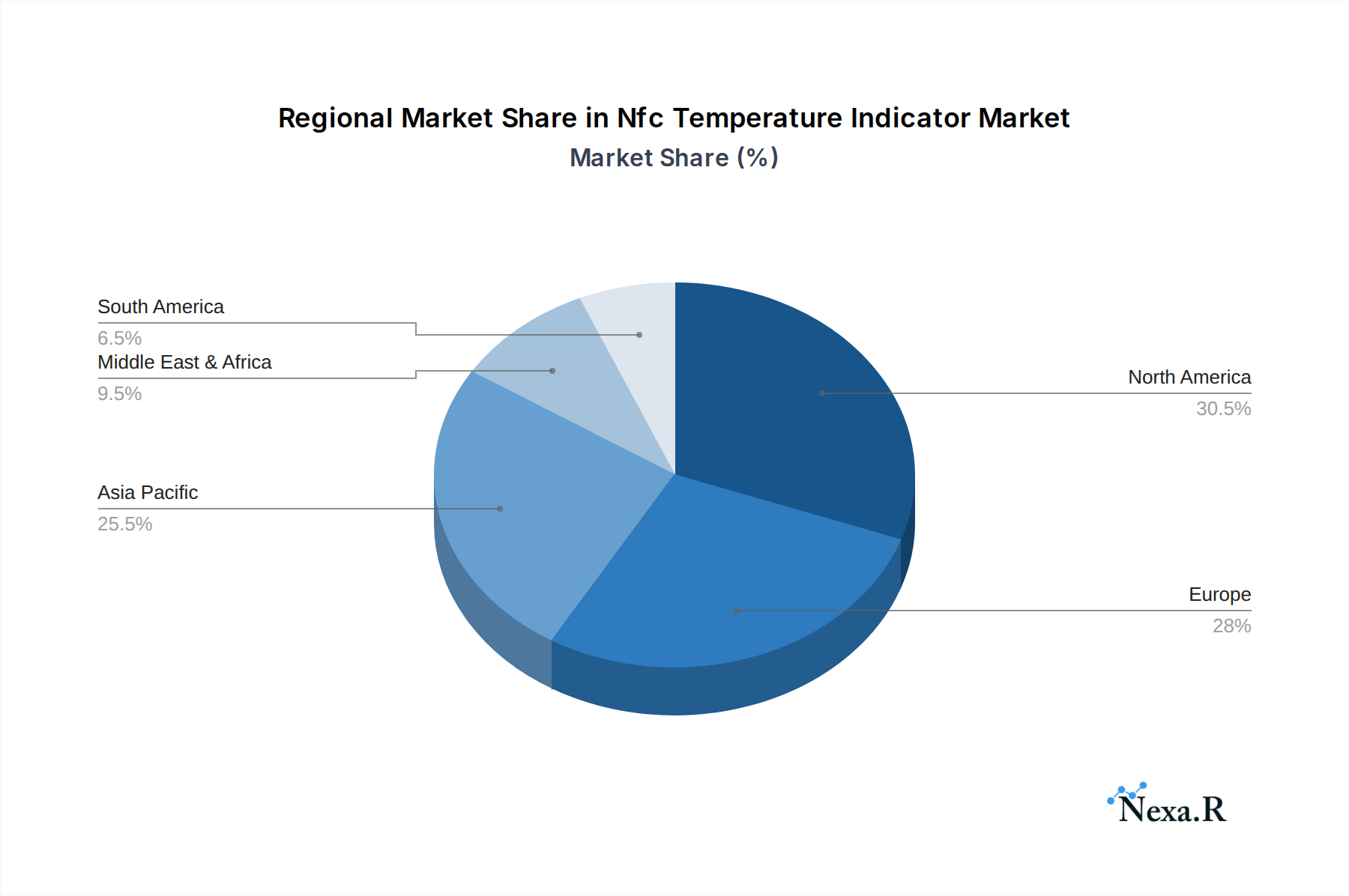
Nfc Temperature Indicator Regional Market Share
Geographic Coverage of Nfc Temperature Indicator
Nfc Temperature Indicator REPORT HIGHLIGHTS
| Aspects | Details |
|---|---|
| Study Period | 2020-2034 |
| Base Year | 2025 |
| Estimated Year | 2026 |
| Forecast Period | 2026-2034 |
| Historical Period | 2020-2025 |
| Growth Rate | CAGR of 7.16% from 2020-2034 |
| Segmentation |
|
Table of Contents
- 1. Introduction
- 1.1. Research Scope
- 1.2. Market Segmentation
- 1.3. Research Methodology
- 1.4. Definitions and Assumptions
- 2. Executive Summary
- 2.1. Introduction
- 3. Market Dynamics
- 3.1. Introduction
- 3.2. Market Drivers
- 3.3. Market Restrains
- 3.4. Market Trends
- 4. Market Factor Analysis
- 4.1. Porters Five Forces
- 4.2. Supply/Value Chain
- 4.3. PESTEL analysis
- 4.4. Market Entropy
- 4.5. Patent/Trademark Analysis
- 5. Global Nfc Temperature Indicator Analysis, Insights and Forecast, 2020-2032
- 5.1. Market Analysis, Insights and Forecast - by Application
- 5.1.1. Medicine
- 5.1.2. Vaccine
- 5.1.3. Blood
- 5.1.4. Food
- 5.1.5. Flower
- 5.1.6. Laboratory
- 5.1.7. Others
- 5.2. Market Analysis, Insights and Forecast - by Type
- 5.2.1. Reusable
- 5.2.2. Single-Use
- 5.3. Market Analysis, Insights and Forecast - by Region
- 5.3.1. North America
- 5.3.2. South America
- 5.3.3. Europe
- 5.3.4. Middle East & Africa
- 5.3.5. Asia Pacific
- 5.1. Market Analysis, Insights and Forecast - by Application
- 6. North America Nfc Temperature Indicator Analysis, Insights and Forecast, 2020-2032
- 6.1. Market Analysis, Insights and Forecast - by Application
- 6.1.1. Medicine
- 6.1.2. Vaccine
- 6.1.3. Blood
- 6.1.4. Food
- 6.1.5. Flower
- 6.1.6. Laboratory
- 6.1.7. Others
- 6.2. Market Analysis, Insights and Forecast - by Type
- 6.2.1. Reusable
- 6.2.2. Single-Use
- 6.1. Market Analysis, Insights and Forecast - by Application
- 7. South America Nfc Temperature Indicator Analysis, Insights and Forecast, 2020-2032
- 7.1. Market Analysis, Insights and Forecast - by Application
- 7.1.1. Medicine
- 7.1.2. Vaccine
- 7.1.3. Blood
- 7.1.4. Food
- 7.1.5. Flower
- 7.1.6. Laboratory
- 7.1.7. Others
- 7.2. Market Analysis, Insights and Forecast - by Type
- 7.2.1. Reusable
- 7.2.2. Single-Use
- 7.1. Market Analysis, Insights and Forecast - by Application
- 8. Europe Nfc Temperature Indicator Analysis, Insights and Forecast, 2020-2032
- 8.1. Market Analysis, Insights and Forecast - by Application
- 8.1.1. Medicine
- 8.1.2. Vaccine
- 8.1.3. Blood
- 8.1.4. Food
- 8.1.5. Flower
- 8.1.6. Laboratory
- 8.1.7. Others
- 8.2. Market Analysis, Insights and Forecast - by Type
- 8.2.1. Reusable
- 8.2.2. Single-Use
- 8.1. Market Analysis, Insights and Forecast - by Application
- 9. Middle East & Africa Nfc Temperature Indicator Analysis, Insights and Forecast, 2020-2032
- 9.1. Market Analysis, Insights and Forecast - by Application
- 9.1.1. Medicine
- 9.1.2. Vaccine
- 9.1.3. Blood
- 9.1.4. Food
- 9.1.5. Flower
- 9.1.6. Laboratory
- 9.1.7. Others
- 9.2. Market Analysis, Insights and Forecast - by Type
- 9.2.1. Reusable
- 9.2.2. Single-Use
- 9.1. Market Analysis, Insights and Forecast - by Application
- 10. Asia Pacific Nfc Temperature Indicator Analysis, Insights and Forecast, 2020-2032
- 10.1. Market Analysis, Insights and Forecast - by Application
- 10.1.1. Medicine
- 10.1.2. Vaccine
- 10.1.3. Blood
- 10.1.4. Food
- 10.1.5. Flower
- 10.1.6. Laboratory
- 10.1.7. Others
- 10.2. Market Analysis, Insights and Forecast - by Type
- 10.2.1. Reusable
- 10.2.2. Single-Use
- 10.1. Market Analysis, Insights and Forecast - by Application
- 11. Competitive Analysis
- 11.1. Global Market Share Analysis 2025
- 11.2. Company Profiles
- 11.2.1 DeltaTrak
- 11.2.1.1. Overview
- 11.2.1.2. Products
- 11.2.1.3. SWOT Analysis
- 11.2.1.4. Recent Developments
- 11.2.1.5. Financials (Based on Availability)
- 11.2.2 Sensitech
- 11.2.2.1. Overview
- 11.2.2.2. Products
- 11.2.2.3. SWOT Analysis
- 11.2.2.4. Recent Developments
- 11.2.2.5. Financials (Based on Availability)
- 11.2.3 Elitech
- 11.2.3.1. Overview
- 11.2.3.2. Products
- 11.2.3.3. SWOT Analysis
- 11.2.3.4. Recent Developments
- 11.2.3.5. Financials (Based on Availability)
- 11.2.4 NOVUS Automation
- 11.2.4.1. Overview
- 11.2.4.2. Products
- 11.2.4.3. SWOT Analysis
- 11.2.4.4. Recent Developments
- 11.2.4.5. Financials (Based on Availability)
- 11.2.5 Thermolabo
- 11.2.5.1. Overview
- 11.2.5.2. Products
- 11.2.5.3. SWOT Analysis
- 11.2.5.4. Recent Developments
- 11.2.5.5. Financials (Based on Availability)
- 11.2.6 Graphic Controls
- 11.2.6.1. Overview
- 11.2.6.2. Products
- 11.2.6.3. SWOT Analysis
- 11.2.6.4. Recent Developments
- 11.2.6.5. Financials (Based on Availability)
- 11.2.7 Xylem
- 11.2.7.1. Overview
- 11.2.7.2. Products
- 11.2.7.3. SWOT Analysis
- 11.2.7.4. Recent Developments
- 11.2.7.5. Financials (Based on Availability)
- 11.2.8 CCL Healthcare
- 11.2.8.1. Overview
- 11.2.8.2. Products
- 11.2.8.3. SWOT Analysis
- 11.2.8.4. Recent Developments
- 11.2.8.5. Financials (Based on Availability)
- 11.2.9 Freshliance Electronics
- 11.2.9.1. Overview
- 11.2.9.2. Products
- 11.2.9.3. SWOT Analysis
- 11.2.9.4. Recent Developments
- 11.2.9.5. Financials (Based on Availability)
- 11.2.10 Tive
- 11.2.10.1. Overview
- 11.2.10.2. Products
- 11.2.10.3. SWOT Analysis
- 11.2.10.4. Recent Developments
- 11.2.10.5. Financials (Based on Availability)
- 11.2.11 Shenzhen Jumaoyuan Science And Technology
- 11.2.11.1. Overview
- 11.2.11.2. Products
- 11.2.11.3. SWOT Analysis
- 11.2.11.4. Recent Developments
- 11.2.11.5. Financials (Based on Availability)
- 11.2.1 DeltaTrak
List of Figures
- Figure 1: Global Nfc Temperature Indicator Revenue Breakdown (undefined, %) by Region 2025 & 2033
- Figure 2: North America Nfc Temperature Indicator Revenue (undefined), by Application 2025 & 2033
- Figure 3: North America Nfc Temperature Indicator Revenue Share (%), by Application 2025 & 2033
- Figure 4: North America Nfc Temperature Indicator Revenue (undefined), by Type 2025 & 2033
- Figure 5: North America Nfc Temperature Indicator Revenue Share (%), by Type 2025 & 2033
- Figure 6: North America Nfc Temperature Indicator Revenue (undefined), by Country 2025 & 2033
- Figure 7: North America Nfc Temperature Indicator Revenue Share (%), by Country 2025 & 2033
- Figure 8: South America Nfc Temperature Indicator Revenue (undefined), by Application 2025 & 2033
- Figure 9: South America Nfc Temperature Indicator Revenue Share (%), by Application 2025 & 2033
- Figure 10: South America Nfc Temperature Indicator Revenue (undefined), by Type 2025 & 2033
- Figure 11: South America Nfc Temperature Indicator Revenue Share (%), by Type 2025 & 2033
- Figure 12: South America Nfc Temperature Indicator Revenue (undefined), by Country 2025 & 2033
- Figure 13: South America Nfc Temperature Indicator Revenue Share (%), by Country 2025 & 2033
- Figure 14: Europe Nfc Temperature Indicator Revenue (undefined), by Application 2025 & 2033
- Figure 15: Europe Nfc Temperature Indicator Revenue Share (%), by Application 2025 & 2033
- Figure 16: Europe Nfc Temperature Indicator Revenue (undefined), by Type 2025 & 2033
- Figure 17: Europe Nfc Temperature Indicator Revenue Share (%), by Type 2025 & 2033
- Figure 18: Europe Nfc Temperature Indicator Revenue (undefined), by Country 2025 & 2033
- Figure 19: Europe Nfc Temperature Indicator Revenue Share (%), by Country 2025 & 2033
- Figure 20: Middle East & Africa Nfc Temperature Indicator Revenue (undefined), by Application 2025 & 2033
- Figure 21: Middle East & Africa Nfc Temperature Indicator Revenue Share (%), by Application 2025 & 2033
- Figure 22: Middle East & Africa Nfc Temperature Indicator Revenue (undefined), by Type 2025 & 2033
- Figure 23: Middle East & Africa Nfc Temperature Indicator Revenue Share (%), by Type 2025 & 2033
- Figure 24: Middle East & Africa Nfc Temperature Indicator Revenue (undefined), by Country 2025 & 2033
- Figure 25: Middle East & Africa Nfc Temperature Indicator Revenue Share (%), by Country 2025 & 2033
- Figure 26: Asia Pacific Nfc Temperature Indicator Revenue (undefined), by Application 2025 & 2033
- Figure 27: Asia Pacific Nfc Temperature Indicator Revenue Share (%), by Application 2025 & 2033
- Figure 28: Asia Pacific Nfc Temperature Indicator Revenue (undefined), by Type 2025 & 2033
- Figure 29: Asia Pacific Nfc Temperature Indicator Revenue Share (%), by Type 2025 & 2033
- Figure 30: Asia Pacific Nfc Temperature Indicator Revenue (undefined), by Country 2025 & 2033
- Figure 31: Asia Pacific Nfc Temperature Indicator Revenue Share (%), by Country 2025 & 2033
List of Tables
- Table 1: Global Nfc Temperature Indicator Revenue undefined Forecast, by Application 2020 & 2033
- Table 2: Global Nfc Temperature Indicator Revenue undefined Forecast, by Type 2020 & 2033
- Table 3: Global Nfc Temperature Indicator Revenue undefined Forecast, by Region 2020 & 2033
- Table 4: Global Nfc Temperature Indicator Revenue undefined Forecast, by Application 2020 & 2033
- Table 5: Global Nfc Temperature Indicator Revenue undefined Forecast, by Type 2020 & 2033
- Table 6: Global Nfc Temperature Indicator Revenue undefined Forecast, by Country 2020 & 2033
- Table 7: United States Nfc Temperature Indicator Revenue (undefined) Forecast, by Application 2020 & 2033
- Table 8: Canada Nfc Temperature Indicator Revenue (undefined) Forecast, by Application 2020 & 2033
- Table 9: Mexico Nfc Temperature Indicator Revenue (undefined) Forecast, by Application 2020 & 2033
- Table 10: Global Nfc Temperature Indicator Revenue undefined Forecast, by Application 2020 & 2033
- Table 11: Global Nfc Temperature Indicator Revenue undefined Forecast, by Type 2020 & 2033
- Table 12: Global Nfc Temperature Indicator Revenue undefined Forecast, by Country 2020 & 2033
- Table 13: Brazil Nfc Temperature Indicator Revenue (undefined) Forecast, by Application 2020 & 2033
- Table 14: Argentina Nfc Temperature Indicator Revenue (undefined) Forecast, by Application 2020 & 2033
- Table 15: Rest of South America Nfc Temperature Indicator Revenue (undefined) Forecast, by Application 2020 & 2033
- Table 16: Global Nfc Temperature Indicator Revenue undefined Forecast, by Application 2020 & 2033
- Table 17: Global Nfc Temperature Indicator Revenue undefined Forecast, by Type 2020 & 2033
- Table 18: Global Nfc Temperature Indicator Revenue undefined Forecast, by Country 2020 & 2033
- Table 19: United Kingdom Nfc Temperature Indicator Revenue (undefined) Forecast, by Application 2020 & 2033
- Table 20: Germany Nfc Temperature Indicator Revenue (undefined) Forecast, by Application 2020 & 2033
- Table 21: France Nfc Temperature Indicator Revenue (undefined) Forecast, by Application 2020 & 2033
- Table 22: Italy Nfc Temperature Indicator Revenue (undefined) Forecast, by Application 2020 & 2033
- Table 23: Spain Nfc Temperature Indicator Revenue (undefined) Forecast, by Application 2020 & 2033
- Table 24: Russia Nfc Temperature Indicator Revenue (undefined) Forecast, by Application 2020 & 2033
- Table 25: Benelux Nfc Temperature Indicator Revenue (undefined) Forecast, by Application 2020 & 2033
- Table 26: Nordics Nfc Temperature Indicator Revenue (undefined) Forecast, by Application 2020 & 2033
- Table 27: Rest of Europe Nfc Temperature Indicator Revenue (undefined) Forecast, by Application 2020 & 2033
- Table 28: Global Nfc Temperature Indicator Revenue undefined Forecast, by Application 2020 & 2033
- Table 29: Global Nfc Temperature Indicator Revenue undefined Forecast, by Type 2020 & 2033
- Table 30: Global Nfc Temperature Indicator Revenue undefined Forecast, by Country 2020 & 2033
- Table 31: Turkey Nfc Temperature Indicator Revenue (undefined) Forecast, by Application 2020 & 2033
- Table 32: Israel Nfc Temperature Indicator Revenue (undefined) Forecast, by Application 2020 & 2033
- Table 33: GCC Nfc Temperature Indicator Revenue (undefined) Forecast, by Application 2020 & 2033
- Table 34: North Africa Nfc Temperature Indicator Revenue (undefined) Forecast, by Application 2020 & 2033
- Table 35: South Africa Nfc Temperature Indicator Revenue (undefined) Forecast, by Application 2020 & 2033
- Table 36: Rest of Middle East & Africa Nfc Temperature Indicator Revenue (undefined) Forecast, by Application 2020 & 2033
- Table 37: Global Nfc Temperature Indicator Revenue undefined Forecast, by Application 2020 & 2033
- Table 38: Global Nfc Temperature Indicator Revenue undefined Forecast, by Type 2020 & 2033
- Table 39: Global Nfc Temperature Indicator Revenue undefined Forecast, by Country 2020 & 2033
- Table 40: China Nfc Temperature Indicator Revenue (undefined) Forecast, by Application 2020 & 2033
- Table 41: India Nfc Temperature Indicator Revenue (undefined) Forecast, by Application 2020 & 2033
- Table 42: Japan Nfc Temperature Indicator Revenue (undefined) Forecast, by Application 2020 & 2033
- Table 43: South Korea Nfc Temperature Indicator Revenue (undefined) Forecast, by Application 2020 & 2033
- Table 44: ASEAN Nfc Temperature Indicator Revenue (undefined) Forecast, by Application 2020 & 2033
- Table 45: Oceania Nfc Temperature Indicator Revenue (undefined) Forecast, by Application 2020 & 2033
- Table 46: Rest of Asia Pacific Nfc Temperature Indicator Revenue (undefined) Forecast, by Application 2020 & 2033
Frequently Asked Questions
1. What is the projected Compound Annual Growth Rate (CAGR) of the Nfc Temperature Indicator?
The projected CAGR is approximately 7.16%.
2. Which companies are prominent players in the Nfc Temperature Indicator?
Key companies in the market include DeltaTrak, Sensitech, Elitech, NOVUS Automation, Thermolabo, Graphic Controls, Xylem, CCL Healthcare, Freshliance Electronics, Tive, Shenzhen Jumaoyuan Science And Technology.
3. What are the main segments of the Nfc Temperature Indicator?
The market segments include Application, Type.
4. Can you provide details about the market size?
The market size is estimated to be USD XXX N/A as of 2022.
5. What are some drivers contributing to market growth?
N/A
6. What are the notable trends driving market growth?
N/A
7. Are there any restraints impacting market growth?
N/A
8. Can you provide examples of recent developments in the market?
N/A
9. What pricing options are available for accessing the report?
Pricing options include single-user, multi-user, and enterprise licenses priced at USD 2900.00, USD 4350.00, and USD 5800.00 respectively.
10. Is the market size provided in terms of value or volume?
The market size is provided in terms of value, measured in N/A.
11. Are there any specific market keywords associated with the report?
Yes, the market keyword associated with the report is "Nfc Temperature Indicator," which aids in identifying and referencing the specific market segment covered.
12. How do I determine which pricing option suits my needs best?
The pricing options vary based on user requirements and access needs. Individual users may opt for single-user licenses, while businesses requiring broader access may choose multi-user or enterprise licenses for cost-effective access to the report.
13. Are there any additional resources or data provided in the Nfc Temperature Indicator report?
While the report offers comprehensive insights, it's advisable to review the specific contents or supplementary materials provided to ascertain if additional resources or data are available.
14. How can I stay updated on further developments or reports in the Nfc Temperature Indicator?
To stay informed about further developments, trends, and reports in the Nfc Temperature Indicator, consider subscribing to industry newsletters, following relevant companies and organizations, or regularly checking reputable industry news sources and publications.
Methodology
Step 1 - Identification of Relevant Samples Size from Population Database



Step 2 - Approaches for Defining Global Market Size (Value, Volume* & Price*)

Note*: In applicable scenarios
Step 3 - Data Sources
Primary Research
- Web Analytics
- Survey Reports
- Research Institute
- Latest Research Reports
- Opinion Leaders
Secondary Research
- Annual Reports
- White Paper
- Latest Press Release
- Industry Association
- Paid Database
- Investor Presentations

Step 4 - Data Triangulation
Involves using different sources of information in order to increase the validity of a study
These sources are likely to be stakeholders in a program - participants, other researchers, program staff, other community members, and so on.
Then we put all data in single framework & apply various statistical tools to find out the dynamic on the market.
During the analysis stage, feedback from the stakeholder groups would be compared to determine areas of agreement as well as areas of divergence